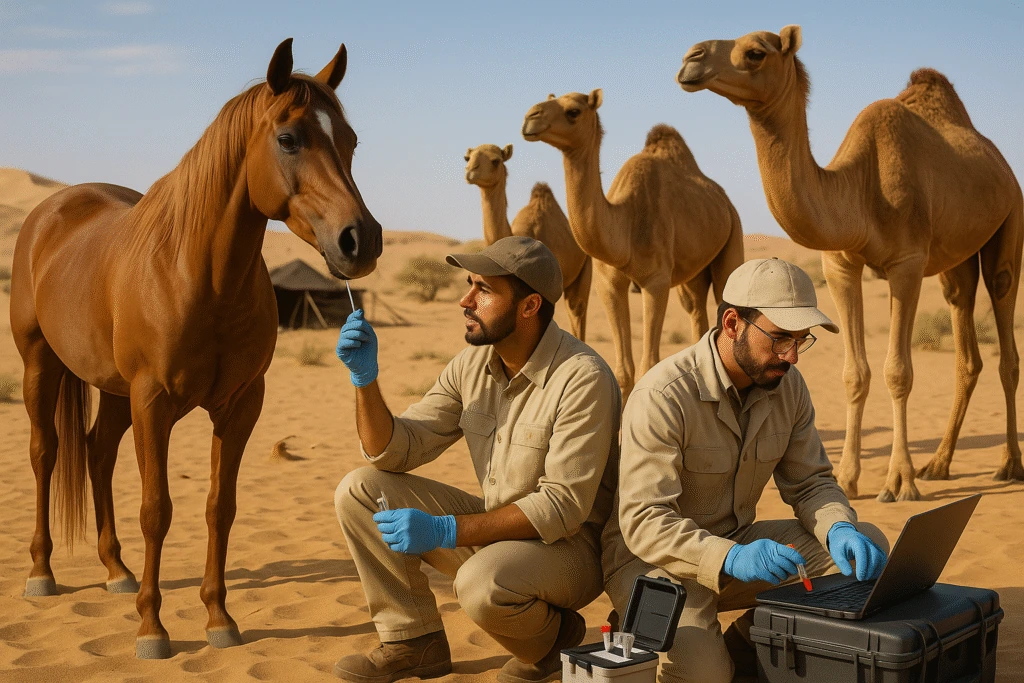
Unlocking the Genetic Secrets of Arabian Horses and Camels: Revolutionizing Livestock Health in Saudi Arabia
The future of equine and camelid excellence lies in understanding their DNA The Genetic Legacy of Desert Champions In the golden sands of Saudi Arabia, two magnificent species have…
The future of equine and camelid excellence lies in understanding their DNA
The Genetic Legacy of Desert Champions In the golden sands of Saudi Arabia, two magnificent species have shaped our heritage for millennia: the noble Arabian horse and the resilient dromedary camel. These aren’t just animals – they’re living treasures carrying thousands of years of genetic wisdom in their DNA. Today, cutting-edge genomics is revolutionizing how we understand, protect, and enhance these remarkable creatures.
Why does genetics matter for horses and camels? Every trait that makes an Arabian horse swift and elegant, or a camel perfectly adapted to desert life, is written in their genetic code. From disease resistance to performance capabilities, from coat color to milk production – it’s all in the DNA.
Arabian Horse Genetics: Preserving Perfection The Genetic Foundation of Excellence Arabian horses possess one of the most refined and ancient genetic profiles in the equine world. Their distinctive characteristics – the dished face, arched neck, and incredible endurance – are the result of thousands of years of careful breeding in the Arabian Peninsula.
Endurance genes: Variants in ACTN3 and MSTN genes contribute to their legendary stamina Coat color genetics: Complex interactions of MC1R, ASIP, and other genes create their beautiful colors Conformation genes: Multiple genetic factors contribute to their distinctive Arabian type Disease resistance: Natural genetic variants provide protection against certain conditions
Common Genetic Diseases in Arabian Horses Despite their genetic excellence, Arabian horses are susceptible to several hereditary conditions:
Affects the immune system, making foals vulnerable to infections Caused by mutations in the DNA-PKcs gene Can be prevented through genetic testing of breeding stock
Neurological condition affecting coordination and balance Progressive condition that appears in young horses Genetic testing allows breeders to make informed decisions
Rare neurological disorder affecting newborn foals Characterized by distinctive coat color and severe neurological symptoms Preventable through carrier testing
Camel Genetics: Desert Adaptation Mastery The Genomic Secrets of Desert Survival Camels are genetic marvels, perfectly engineered by evolution for desert life. Their genome reveals fascinating adaptations that allow them to thrive where other animals cannot survive.
Water conservation genes: Enhanced kidney function and water retention mechanisms Temperature regulation: Genetic variants for heat tolerance and thermal regulation Immune system: Unique antibody structures providing superior disease resistance Metabolic efficiency: Genes enabling survival on minimal food and water
Genetic Diseases in Camels While incredibly hardy, camels can suffer from several genetic conditions:
Cleft palate and limb deformities Often linked to inbreeding in closed populations Genetic diversity testing helps prevent these issues
Inherited conditions affecting fat and protein metabolism Can impact milk production and overall health Early detection through genetic screening is crucial
Genetic factors affecting fertility and breeding success Particularly important for valuable breeding animals Genomic selection can improve reproductive performance
Revolutionary Genomic Services: The Embryo Advantage Comprehensive Genetic Testing Solutions Modern genomic services are transforming how we care for horses and camels in Saudi Arabia. Here’s how advanced genetic testing is making a difference:
Pre-breeding genetic testing to identify carriers of hereditary diseases Early detection of genetic conditions before symptoms