One Species or Two? Resolving the Arabian Burrowing Asp Question with Molecular Phylogenetics
Embryo's 16S + CMOS phylogeny of 25 Arabian Atractaspis specimens shows A. andersonii and A. engaddensis are conspecific — two subspecies, not two species. Saudi-led herpetology genomics.
The venomous black burrowing asps of the Arabian Peninsula have been treated by different authorities as either one species with two subspecies (A. andersonii andersonii and A. andersonii engaddensis) or as two fully-separate species (A. andersonii and A. engaddensis). Either answer has direct consequences — for antivenom design, for protected-species lists, for biodiversity policy. Embryo applied maximum-likelihood phylogenetics on two independent molecular markers — mitochondrial 16S rRNA and nuclear CMOS — to give a defensible answer.
Why a taxonomic question is a Vision 2030 question
Saudi Arabia's National Center for Wildlife maintains species lists used in conservation, hunting, and reserve management. Antivenom programmes design products against named taxa. International CITES classifications track species, not subspecies. Knowing exactly how many species you have is not academic — it shapes regulation, medicine, and biodiversity policy. A Saudi-led molecular answer to a Saudi taxonomic question is exactly the sovereign capability Vision 2030 calls for.
Abstract
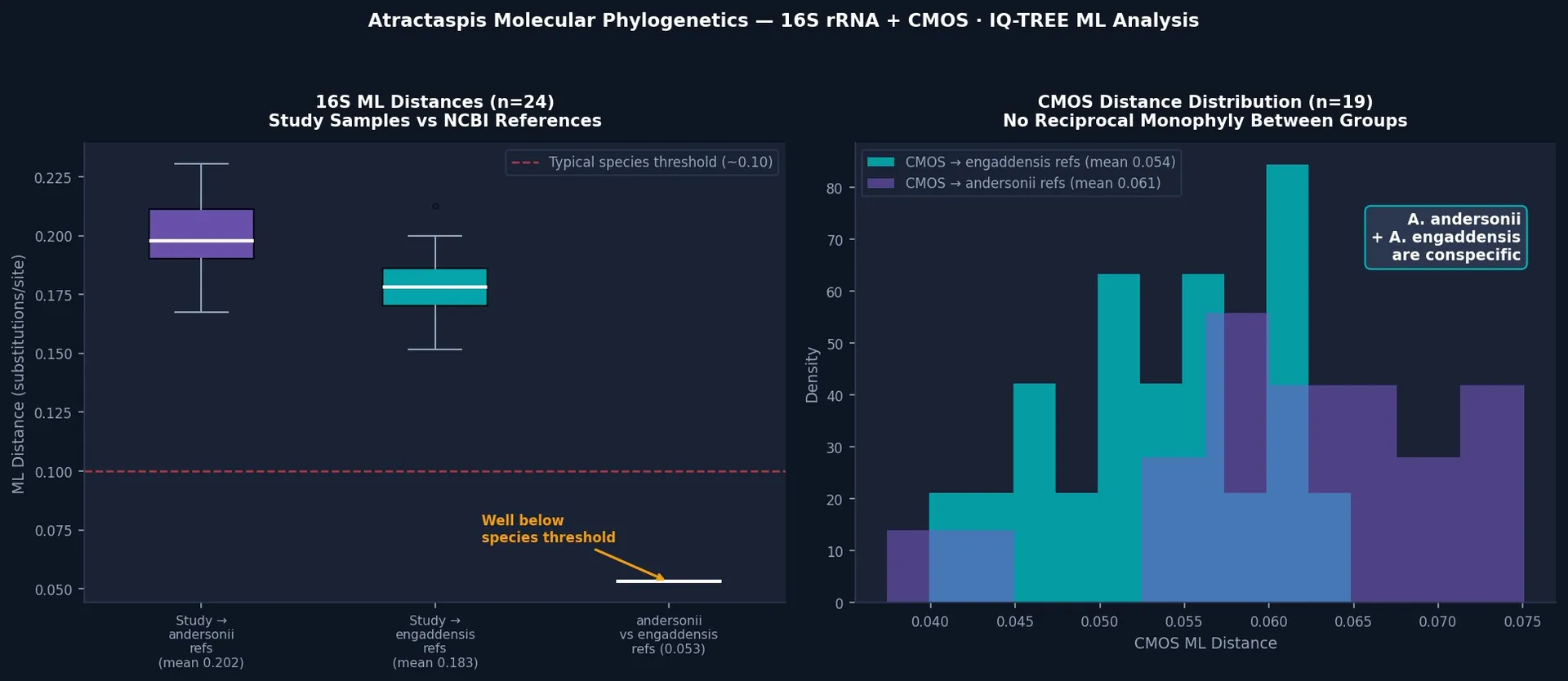
The venomous black burrowing asps of the Arabian Peninsula have been variously treated as a single species with two subspecies (A. andersonii andersonii and A. andersonii engaddensis) or as two fully-separate species. We applied maximum-likelihood phylogenetics and distance-based population analyses to two independent molecular markers — mitochondrial 16S rRNA (n=25 specimens) and nuclear CMOS (n=19) — sequenced on Illumina NovaSeq. ML phylogeny used IQ-TREE; we additionally performed PCoA, distance-based admixture, and pairwise ML distance comparisons against NCBI reference sequences. NCBI reference plastids of the two named species themselves differ by a mean ML distance of only 0.053 in 16S — well below typical species-level divergence. All 19 CMOS study samples match A. engaddensis NCBI vouchers at 91–99% identity (mean distance to refs 0.054). E-suffix vs. non-E-suffix samples are intermixed in both the ML tree and PCoA, with between-group distances (mean 0.122) lower than within-group variance. Across all lines of evidence, the data are most parsimoniously consistent with A. andersonii and A. engaddensis being conspecific.
Methods
Twenty-five specimens were sampled for 16S rRNA; nineteen specimens were sampled for CMOS. Libraries were sequenced on an Illumina NovaSeq platform. Maximum-likelihood phylogenies were inferred with IQ-TREE (MFP model selection) using study sequences plus NCBI A. andersonii / A. engaddensis / outgroup references. Pairwise ML distances were calculated as proportional substitutions per site. PCoA used metric MDS on ML distances with k-means clustering and silhouette-based k selection. Distance-based admixture used inverse-distance proportions to reference species clusters. Sample 4E_A was excluded from tree visualisations (anomalously long branch indicating a degraded or chimeric sequence) but retained in distance analyses.
Results
The 16S ML tree placed all 24 andersonii-classified study samples in a single well-supported clade with NCBI A. andersonii references — and the NCBI A. engaddensis references clustered within or immediately adjacent to the same clade, not forming a separate deeply divergent lineage. Pairwise ML distances confirmed the pattern: distances from study samples to NCBI andersonii refs (mean 0.202) were essentially equal to distances to NCBI engaddensis refs (mean 0.183), and the two reference species themselves differed by only 0.053 — well below typical species-level divergence. The CMOS ML tree placed all 19 study samples in a single cohesive engaddensis clade with no reciprocal monophyly separating E-suffix from non-E samples; mean distance to NCBI engaddensis refs was 0.054. PCoA showed continuous distributions with no deep gap. Distance-based admixture produced no mixed-ancestry individuals — every study sample was uniformly assigned to a single reference cluster per gene. Geographically, neither 16S nor CMOS recovered a split corresponding to the proposed north-south taxon boundary. The molecular evidence is consistent with A. andersonii and A. engaddensis being conspecific — two subspecies of a single species rather than fully-independent species.
What this means in practice
Three practical follow-ons. First, antivenom programmes targeting Arabian Atractaspis can confidently treat A. andersonii and A. engaddensis as a single antigenic target — the molecular distance is too small to expect significant antigenic divergence. Second, conservation policy and CITES reporting should treat the two as a single species with subspecies, not as separate species. Third, this is a useful reminder that taxonomy benefits from periodic molecular re-examination — and that Embryo can deliver that re-examination for any Saudi species complex where the answer is contested.
Have a contested species complex that needs a definitive molecular answer? Embryo delivers multi-marker ML phylogeny + distance + PCoA + admixture, with the figures and tables a peer review demands.
Learn more →