Why Do Some Children with Down Syndrome Develop Heart Defects? An Integrated WES + WGS Study
Roughly half of children with Down syndrome develop congenital heart disease — but why some and not others is unresolved. Embryo integrated a 22-person whole-exome cohort with whole-genome sequencing of a consanguineous family quartet to build an oligogenic model of cardiac risk on the trisomic background.
About half of all children born with Down syndrome (trisomy 21) also have congenital heart disease (CHD) — and the other half do not. What genetic factors decide which? To probe that question, Embryo integrated two complementary datasets: a whole-exome sequencing (WES) case-control cohort of 22 individuals with trisomy 21 (17 with CHD, 5 without), and whole-genome sequencing (WGS) of a consanguineous family quartet in which both daughters have Down syndrome and congenital heart disease. This report is Iteration 4 of that analysis.
First, confirm the trisomy from the data itself
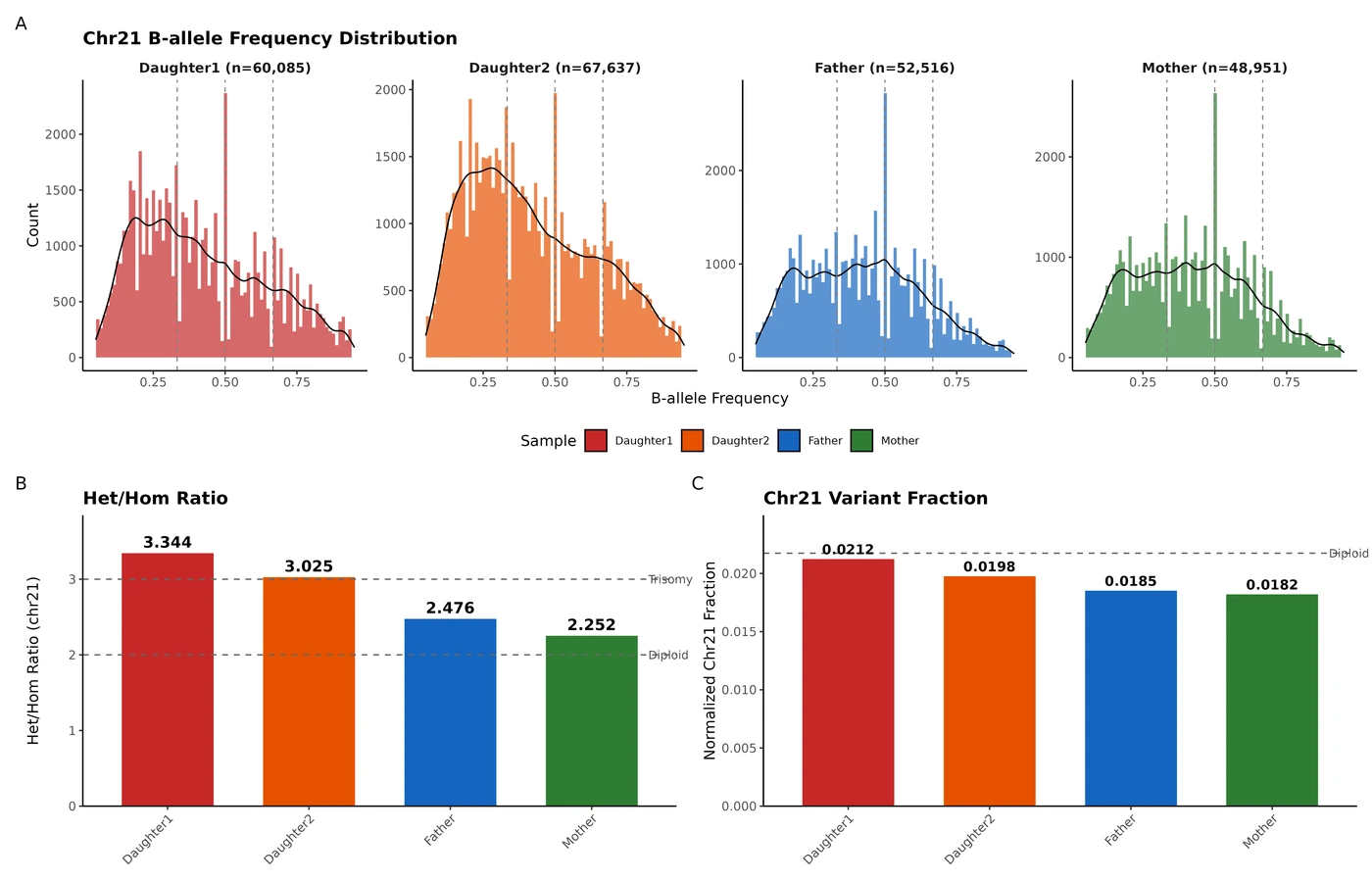
Before interpreting modifier genes, the analysis confirmed trisomy 21 directly from the sequencing data. The chromosome-21 heterozygous-to-homozygous variant ratio was 3.34 in Daughter 1 and 3.03 in Daughter 2 — sitting at the expected trisomy value of ~3 — versus 2.48 and 2.25 in the euploid father and mother, near the diploid value of 2. The B-allele frequency distributions and normalised chr21 variant fractions told the same story. Genome-first dosage confirmation, no karyotype required.
An oligogenic model, not a single cause
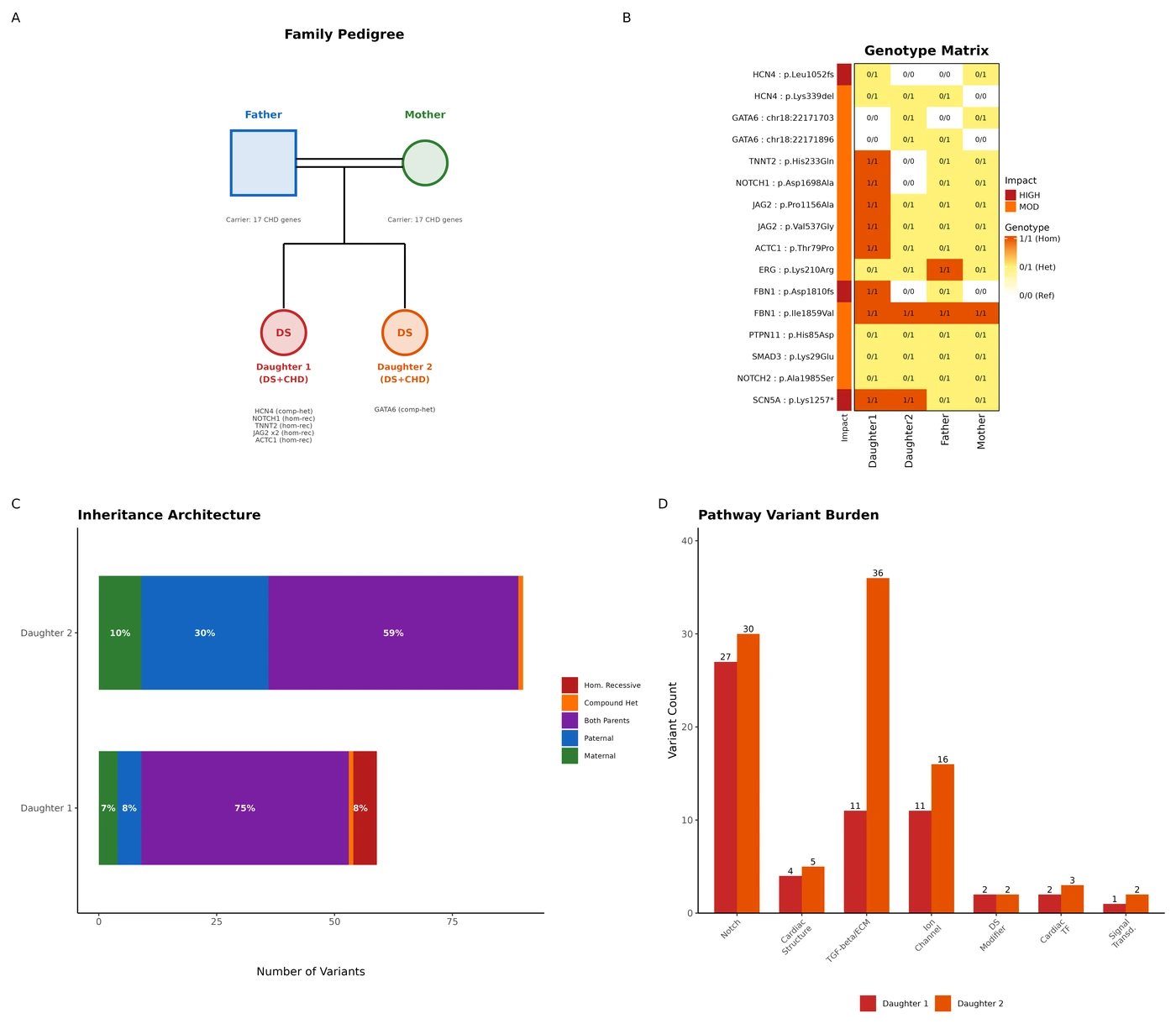
The central finding is that CHD on the trisomic background is not driven by one gene. Instead, a multi-gene, multi-pathway rare-variant burden in core cardiac-development genes converges on the trisomy. Pathway-level integration highlighted heavy burden in Notch signalling (NOTCH1, NOTCH2, JAG1, JAG2), the TGF-beta/extracellular-matrix module (FBN1, SMAD3, TGFBR1), ion-channel genes (HCN4, SCN5A, KCNQ1) and cardiac-structure genes — an oligogenic architecture in which several modest-effect variants combine to tip the balance toward a heart defect.
NOTCH1 leads the candidate list
Cross-referencing damaging variants in the family against enrichment in the WES cohort produced an evidence-ranked candidate list, and NOTCH1 came out on top (evidence score 8/10). Daughter 1 carries a homozygous recessive NOTCH1 missense variant (p.Asp1698Ala), consistent with the consanguineous pedigree and with NOTCH1's established central role in cardiac and valve development. She carries a particularly heavy biallelic burden overall — homozygous-recessive hits in NOTCH1, TNNT2, JAG2 and ACTC1 among them — while Daughter 2's architecture is dominated by variants inherited from both parents.
HMGN1: a dosage effect, not a mutation
One chromosome-21 gene deserved special scrutiny. HMGN1 is a dosage-sensitive, nucleosome-binding epigenetic regulator located in the Down syndrome critical region (21q22.3). It is present in three copies in every individual with trisomy 21 — but it carried no damaging coding variant. Its contribution is therefore gene dosage, not sequence disruption: the extra copy alters expression rather than protein function. This distinction matters, because a dosage effector will never appear in a standard variant-filtered candidate table, yet can still be biologically important — a point consistent with recently published functional work.
What integration buys you
Neither dataset alone would have told this story. The WES cohort supplies population-level enrichment signals — which genes are seen more often in DS+CHD than in DS-without-CHD — while the WGS family quartet supplies mechanism: de novo, compound-heterozygous and homozygous-recessive resolution that a case-control exome cannot provide. Layering pedigree-aware genome data on top of a targeted cohort turns a list of candidate genes into an evidence-ranked, mechanism-annotated model of why a heart defect develops on the trisomic background. As a clinical-research resource, this is exactly the kind of integrated analysis that moves a difficult question forward.
Explore the full platform data, publications, and research tools:
Discuss a Clinical Genomics Project →