E. coli WGS for Food Safety: Embryo's Regulatory-Grade Pipeline
Embryo's NovaSeq-based E. coli WGS pipeline delivers regulatory-grade food-safety workflows — per-isolate assemblies, annotation, and downstream AMR / virulence / outbreak modules.
Food safety is a Vision 2030 food-security cornerstone. Whole-genome sequencing of bacterial isolates has become the global standard for outbreak source attribution, serotyping, antimicrobial-resistance profiling, and virulence-factor screening. Embryo's E. coli WGS pipeline is operationally ready for regulatory-grade food-safety workflows: ten isolates have been processed end-to-end on Illumina NovaSeq with publication-grade outputs.
Why this matters
When an outbreak happens — in a dairy supply chain, a poultry plant, a water bottling facility — the speed and quality of the molecular response determines how quickly the source is identified and contained. Routine surveillance WGS turns reactive investigations into proactive risk management. A Saudi-built pipeline keeps the data, the analysis, and the regulatory dossier in-Kingdom.
Abstract
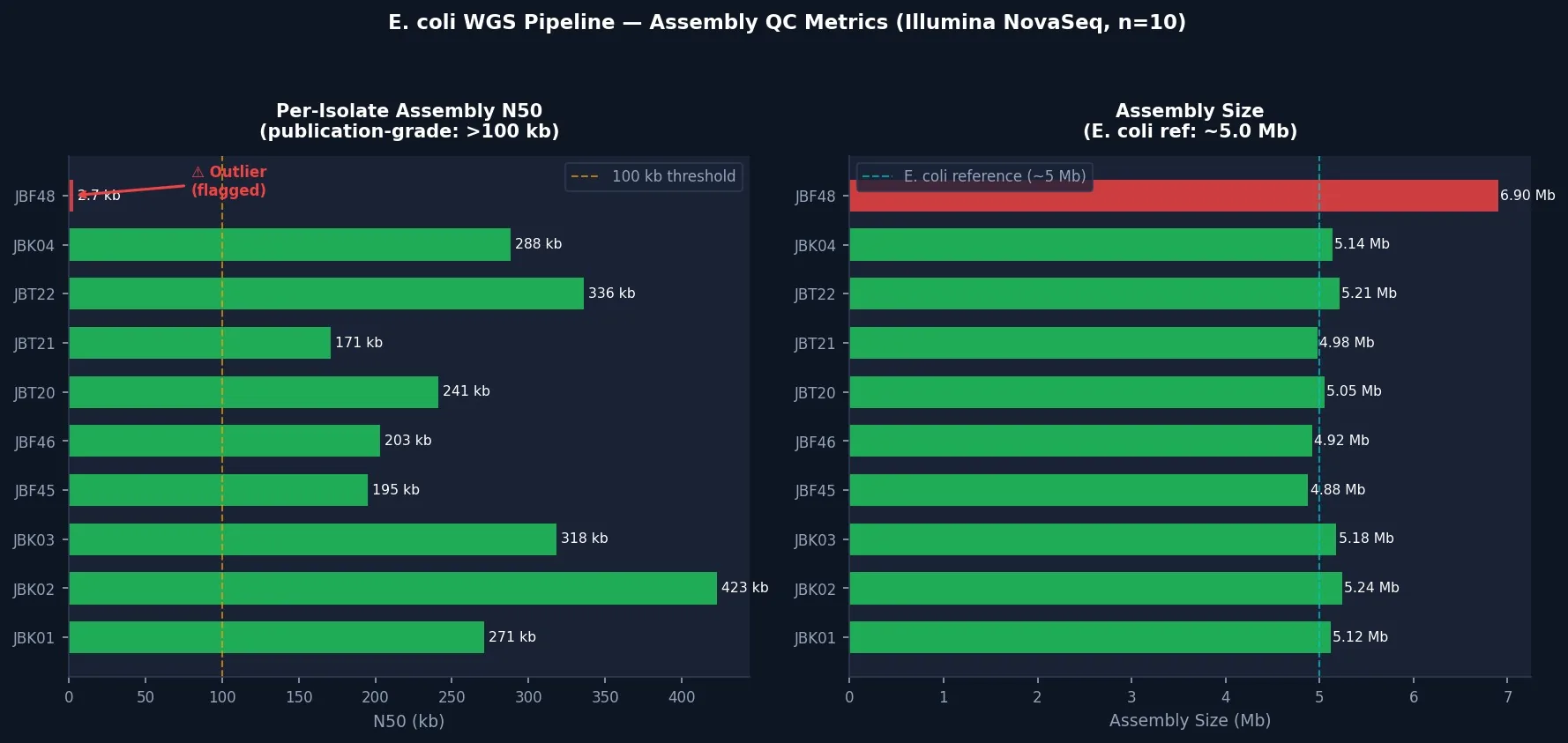
Ten Escherichia coli isolates were sequenced on an Illumina NovaSeq platform as paired-end 150 bp libraries, generating approximately 4 million read pairs per isolate (Q30 ≥ 95% in all samples; GC content ~50%, consistent with E. coli). Reads were quality-trimmed with fastp; assemblies were generated with SPAdes; quality was assessed with QUAST; gene-space completeness was assessed with BUSCO; and protein-coding annotation was performed with Prokka. Quality control was tracked centrally through MultiQC. Eight of the ten isolates produced N50 values between 171 kb and 423 kb on assemblies of 4.88–5.24 Mb — well within publication-grade range for E. coli short-read assemblies. Two isolates produced atypical results requiring follow-up. The pipeline produces a manuscript-ready dossier per isolate suitable for downstream serotyping, AMR, virulence, plasmid replicon, and outbreak phylogeny modules.
Methods
Ten E. coli isolates (JBK / JBF / JBT identifiers) were prepared as paired-end 150 bp libraries and sequenced on Illumina NovaSeq. fastp was used for adapter, low-quality, and poly-G trimming. FastQC and MultiQC tracked per-sample and cohort-level QC. SPAdes performed de novo assembly. QUAST measured contiguity (N50, total length, contig count). BUSCO against the bacteria lineage measured gene-space completeness. Prokka (--kingdom Bacteria) performed CDS, rRNA, and tRNA annotation. The pipeline is structured so that downstream modules — SerotypeFinder, abricate (NCBI / CARD / ResFinder), AMRFinderPlus, VFDB / EcoliVF, PlasmidFinder, MLST, parsnp / kSNP — plug into the same per-isolate input.
Results
All ten isolates produced paired-end reads of 150 bp with Q30 ≥ 95% and 100% post-trimming survival. GC content was ~50% in all isolates, consistent with E. coli. Eight isolates produced N50 between 171 kb and 423 kb on assemblies of 4.88–5.24 Mb — within publication-grade bounds for E. coli short-read assemblies. Isolate 7-B-JBF48 produced an atypical assembly (total length 6.90 Mb, N50 = 2.7 kb) that suggests mixed culture, plasmid abundance, or species mis-identification — flagged for re-extraction and a Kraken2 contamination screen. Per-isolate Prokka annotation produced CDS, rRNA, and tRNA tracks suitable for downstream regulatory-grade workflows.
What this enables
The same per-isolate dossier supports four standard regulatory workflows: (1) serotype assignment for epidemiology, (2) AMR profile for stewardship decisions, (3) virulence and plasmid-replicon screening for risk classification, and (4) MLST / phylogeny for outbreak source attribution. A 10–20 isolate panel can be processed within days, with the regulatory dossier delivered as a structured report rather than a pile of raw VCF files.
Need regulatory-grade WGS for a food-safety isolate panel or an active outbreak investigation? Embryo's pipeline is operationally ready — Illumina NovaSeq throughput, manuscript-ready dossiers, in-Kingdom.
Learn more →