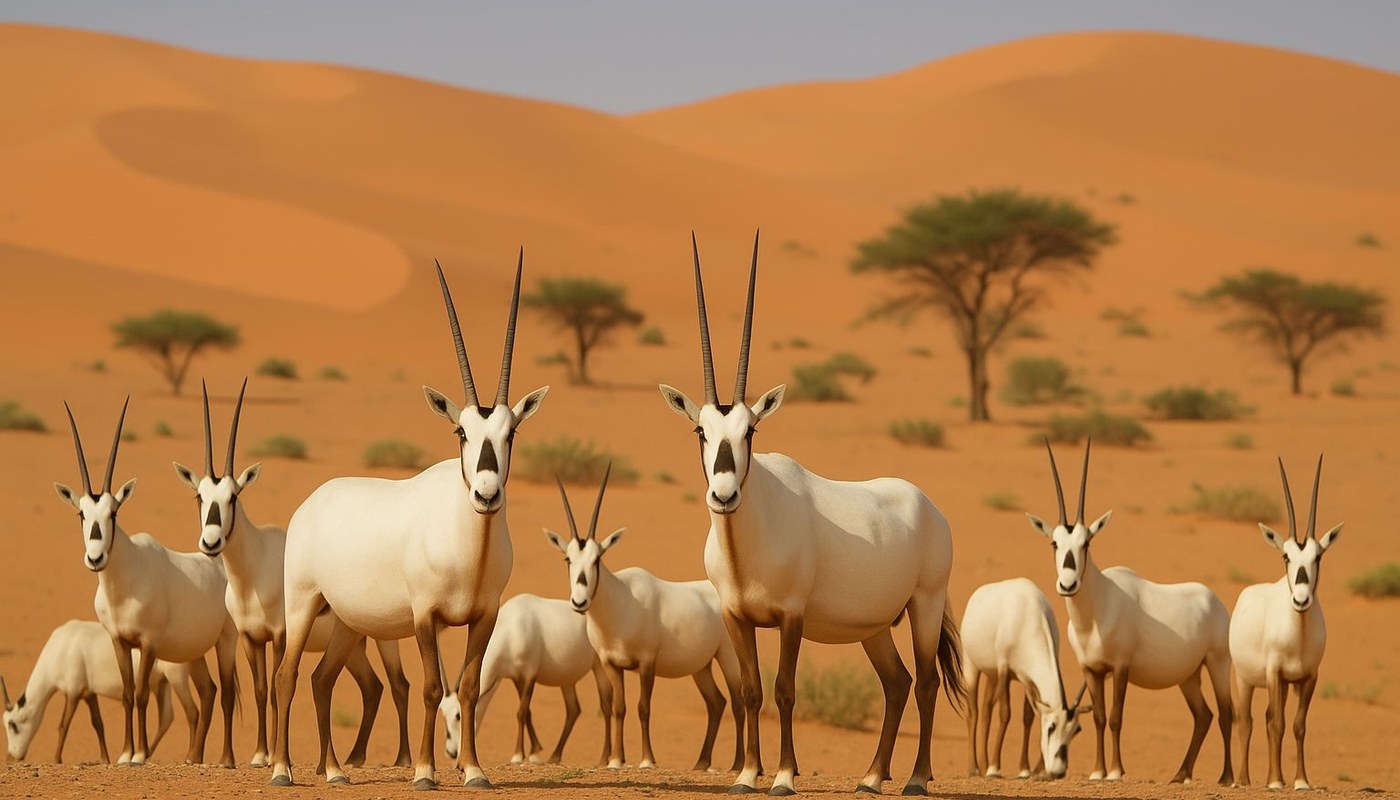
Embryo Partners with Almaha Reserve on Arabian Oryx Conservation
Embryo is partnering with Almaha Reserve (مؤسسة المها الوضيحي) — a wildlife reserve in Al-Kharj, around 80 km south of Riyadh — to bring conservation genomics to the management of its herds. The Arabian oryx is one of conservation's great recoveries; keeping it recovered is a genetic problem as much as a habitat one.
The Arabian oryx is the animal conservation biology points to when it wants to prove that recovery is possible. Declared extinct in the wild in the early 1970s, it was brought back through captive breeding and reintroduction, and now numbers well over a thousand animals across the Arabian Peninsula. Saudi Arabia has been central to that story. But a species rescued from a small number of founders carries the genetic signature of that bottleneck for a very long time — and reserves managing herds today are managing that inheritance, whether or not they can see it. Embryo is partnering with Almaha Reserve to make it visible.
Who Almaha Reserve Is
مؤسسة المها الوضيحي — Almaha Reserve — is a wildlife reserve in Al-Kharj, roughly 80 kilometres south of Riyadh. Its stated mission is leadership in the protection of wildlife and the support of eco-tourism: conservation of rare species alongside a place people can actually visit and learn in. Its name and its emblem are the same animal — الوضيحي, the Arabian oryx — rendered in calligraphy that doubles as the head of the animal itself.
Why Genomics Belongs in a Reserve
Reserve populations face a problem that headcounts do not reveal. When a population is rebuilt from a small number of founders, every subsequent generation redistributes a limited pool of genetic variation. Relatedness accumulates quietly. Two animals that look unrelated on a studbook can share far more of their genome than their records suggest, and pairing them costs the population diversity it cannot easily get back. The visible consequences — reduced fertility, weaker disease resistance, higher juvenile mortality — tend to arrive after the genetic cause is well established.
Genomic tools change the order of those events. Genome-wide SNP genotyping measures actual relatedness between individuals rather than inferring it from pedigree. Runs of homozygosity quantify how much inbreeding a given animal already carries, and how recent it is. Together they let a reserve answer the questions that matter operationally: which animals should be paired, which should be exchanged with another population, and which lineages are underrepresented and worth protecting.
What the Partnership Sets Out to Do
The work ahead is to give Almaha Reserve a genetic picture of its herds to sit alongside the ecological one it already maintains. That means establishing a genomic baseline for the population, quantifying diversity and inbreeding, resolving relatedness among breeding animals, and turning those results into breeding guidance a reserve manager can act on — not a report that ends at the discussion section.
Embryo brings the same conservation genomics capability it applies elsewhere in the Kingdom: population genetics and parentage verification, eDNA and biodiversity survey methods, and the EMB-Conservation platform, which already tracks genomic records, IUCN status, and programme data for Saudi wildlife in one place. Almaha brings the animals, the ground truth, and decades of the husbandry knowledge no sequencer produces.
Conservation and Eco-Tourism Are the Same Project
Almaha Reserve is a conservation organisation and a visitor destination at once, and that combination is deliberate. A reserve that people visit is a reserve that funds itself, builds a constituency, and teaches. Genomic management supports that directly: healthier herds, better-informed breeding, and a defensible scientific account of what the reserve is protecting and why it matters.
It also aligns with the direction of national policy. Saudi Vision 2030 and the Saudi Green Initiative commit the Kingdom to substantial expansion of protected land and to restoring native species across it. Meeting those targets is not only a matter of designating hectares; it depends on whether the populations inside them stay genetically viable across generations. That is the layer this partnership is aimed at.
Go and See It
Reading about the Arabian oryx is not the same as standing in front of one. Almaha Reserve is open to visitors, and at roughly 80 kilometres south of Riyadh it is an easy day trip — close enough to leave after breakfast and be back for dinner, far enough that the city is genuinely behind you.
A few things worth knowing before you go, from anyone who has spent time watching desert wildlife. Go early or go late: oryx and most desert species are active around dawn and dusk and spend the middle of the day resting in whatever shade they can find, so a midday visit shows you far less. Favour the cooler months if you can, roughly November through March, when both the animals and the visitors are more comfortable. Bring more water than you think you need, and something to cover your head. Binoculars transform the experience — desert animals keep their distance, and detail you would otherwise miss is what makes the visit memorable. And move slowly and quietly once you are near the animals; patience is rewarded far more than pursuit.
If you are bringing children, the oryx is a genuinely good story to tell them on the way: an animal that was gone from the wild entirely, and is standing in front of them because people decided to bring it back. Very few conservation stories can be pointed at so directly.
Check the reserve's own site for opening times, booking, and what is available on the day before you travel — those details are theirs to give, and they change with the season.
What Comes Next
We will publish results from this collaboration as they become available, in the same way we publish our other conservation work — with the data, the methods, and the limitations stated plainly. Reserves elsewhere in the Kingdom face the same genetic questions, and the answers are more useful shared than held.
Organisations managing wildlife populations who want to understand the genetic health of their herds are welcome to get in touch.
Plan a visit to Almaha Reserve — opening times, booking, and what to expect on the day:
Visit Almaha Reserve →