EMB-Conservation: Saudi Arabia's First Genomics-Integrated Wildlife Dashboard
EMB-Conservation is Saudi Arabia's first platform to bring genomic data and wildlife population statistics into a single real-time dashboard — tracking 10 iconic species, 594 NCBI sequences, 16 protected reserves, and 6 active conservation programmes aligned with Vision 2030.
Saudi Arabia is home to some of the most ecologically remarkable wildlife on the Arabian Peninsula — from the Critically Endangered Arabian Leopard, with fewer than 200 individuals remaining, to the Arabian Oryx, which was once extinct in the wild and now numbers more than 1,000 after one of conservation biology's greatest recovery stories. Yet for decades, the data underpinning these efforts — genomic records, population counts, reserve boundaries, policy frameworks — lived in disconnected silos. EMB-Conservation changes that. Built by Embryo Co., it is the Kingdom's first integrated conservation genomics dashboard, and it is now available at conservation.embryo.sa.
What the Platform Tracks
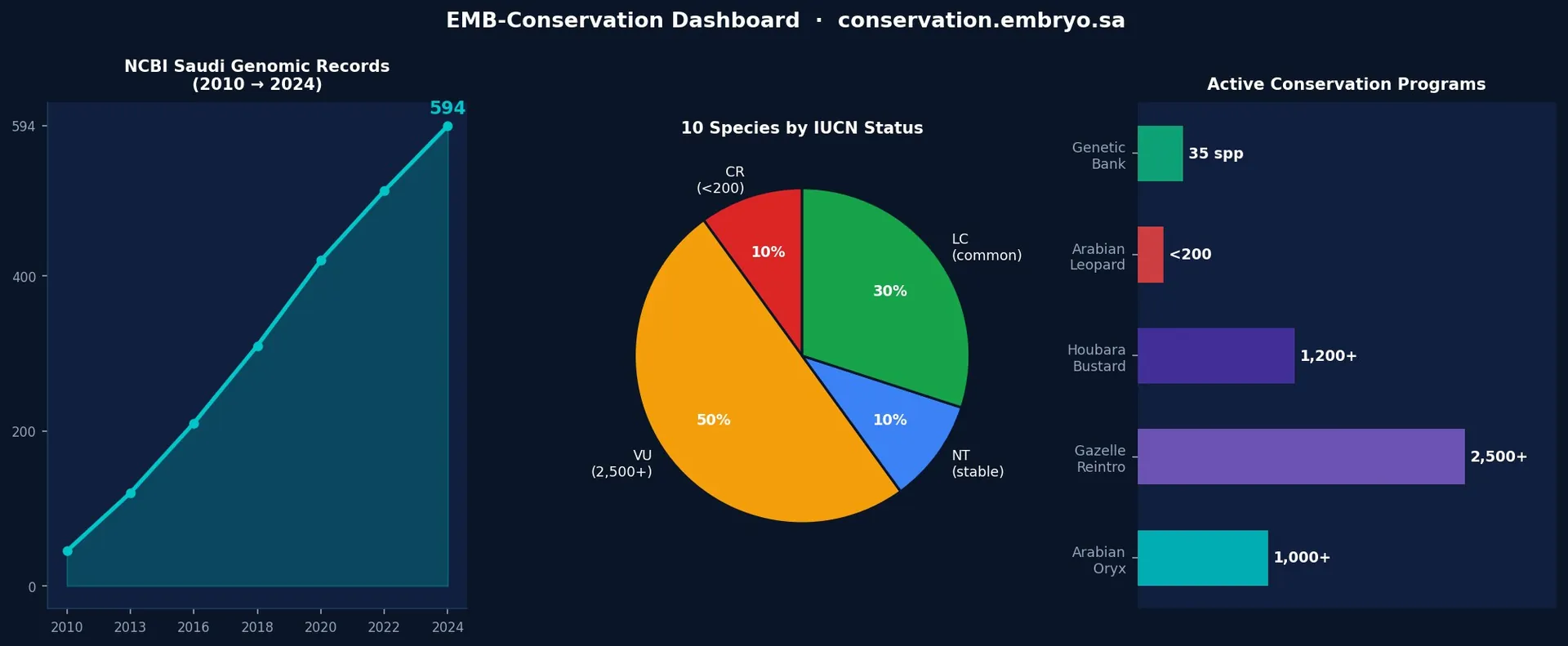
The dashboard aggregates data across four interconnected layers. First, genomic records: 594 Saudi-deposited nucleotide sequences in NCBI, drawn from 10 wildlife populations, with growth charted from 45 records in 2010 to 594 in 2024. Second, species profiles: 10 iconic Saudi species with IUCN status, habitat range, Saudi region distribution, biotechnology methods applied, and key peer-reviewed references for each. Third, protected areas: all 16 Saudi National Wildlife Commission-designated reserves, mapped interactively with species presence and conservation programme linkages. Fourth, conservation programmes: six active national initiatives — from the Arabian Oryx Recovery Programme to the Genetic Conservation Bank — with real-time status indicators, animal counts, and linked scientific evidence.
The 10 Species
The platform profiles a deliberately curated set of Saudi flagship species. The Arabian Oryx (Oryx leucoryx) — Vulnerable, 1,000+ wild individuals — is tracked using microsatellite genotyping for inbreeding management across reintroduced herds. The Nubian Ibex (Capra nubiana) occupies the rocky Hejaz, Asir, and Tabuk mountain ranges, studied via mtDNA D-loop analysis for population connectivity. The Arabian Gazelle (Gazella arabica), Sand Gazelle (Gazella marica), Mountain Gazelle (Gazella gazella), and Goitered Gazelle (Gazella subgutturosa) — all Vulnerable — are monitored across reserve metapopulations using mitochondrial phylogeography and SNP-based population genetics. The Arabian Wildcat (Felis lybica), genetically differentiated from domestic Felis catus populations, is tracked in rocky desert habitats. The Red-necked Ostrich is under habitat restoration monitoring near Riyadh with the largest Saudi NCBI dataset of any tracked species (21 records). The Arabian Wolf (Canis lupus arabs) is profiled using mtDNA phylogenetics distinguishing it from the Eurasian grey wolf lineage. And the Arabian Leopard (Panthera pardus nimr) — Critically Endangered, fewer than 200 remaining — is the focus of whole-genome sequencing work for genetic rescue, with an active breeding programme at Sharaan Nature Reserve in AlUla.
Six Active Conservation Programmes
The dashboard organises national efforts into six programme categories. The Arabian Oryx Recovery Programme — Saudi Arabia's greatest conservation success — achieved IUCN downlisting from Extinct in the Wild to Vulnerable through decades of captive breeding and reintroduction across Uruq Bani Ma'arid and Mahazat as-Sayd reserves. The Gazelle Reintroduction Programme manages 2,500+ individuals of four gazelle species across 16 reserves, supported by 400 Saudi-deposited NCBI records. The Arabian Leopard Initiative operates under a Royal Commission for AlUla partnership at Sharaan Nature Reserve, applying whole-genome sequencing for genetic rescue of a population estimated at under 200 individuals. The Houbara Bustard Breeding Programme produces 1,200+ birds annually for release across northern reserves. The Genetic Conservation Bank cryopreserves genetic material — sperm, oocytes, tissue, and DNA — from 35 Saudi wildlife species, providing insurance against extinction. The Anti-Poaching and Surveillance Programme deploys field rangers, drones, and AI-powered camera traps across all 16 protected areas, with satellite tracking collars on 200+ reintroduced animals.
Genomic Growth: 45 Records in 2010 to 594 in 2024
One of the most striking features of the dashboard is the NCBI genomic record growth chart: from 45 Saudi-deposited sequences in 2010 to 594 by 2024 — a 13× increase in 14 years driven by the spread of next-generation sequencing into conservation biology. Despite this growth, a 2024 systematic review by Alharbi et al. found that 78% of Saudi wildlife studies still rely on mitochondrial markers, with significant gaps in nuclear and whole-genome studies. The dashboard makes this gap visible in real time: by showing which species have shallow genomic coverage, it helps prioritise where sequencing investment is most needed. Embryo's own work on the Arabian Leopard (whole-genome), Arabian Ostrich (chromosome-level assembly), and Arabian Wolf (mtDNA phylogenetics) directly contributes to closing these gaps.
Vision 2030 Alignment
The platform's Vision 2030 tracker monitors four headline targets drawn directly from the Saudi Green Initiative. Protected land coverage currently stands at 18% of Saudi territory, against a 30% target. The 10 billion trees programme has planted approximately 137 million trees to date. Over 7,000 animals have been reintroduced to native habitats by the National Center for Wildlife. And the 594 NCBI genomic records represent an evidence base that directly supports the scientific credibility of reintroduction decisions. By surfacing these numbers on a single screen alongside the species and programme data that generated them, the dashboard creates a live accountability layer for conservation commitments — one that researchers, policymakers, and journalists can access directly.
Platform Features and Roadmap
EMB-Conservation is built on a modern React front-end with a Node.js / Express API backend, hosted on cPanel at conservation.embryo.sa. Current features include: interactive species profiles with habitat maps and biotechnology method summaries; an NCBI genomic records explorer with growth trends by species; a protected areas map with reserve boundaries and species presence layers; a conservation programmes tracker with real-time status badges; an integrated AI conservation assistant (ConservationBot) for guided exploration; and full Arabic/English bilingual support throughout. The platform is under active development. Planned additions include: environmental DNA (eDNA) monitoring data feeds; predictive modelling for climate-change habitat shifts; community science data integration; BLAST sequence search for researchers; and a public API for programmatic data access.
Explore the EMB-Conservation dashboard — Saudi Arabia's first genomics-integrated wildlife platform. Currently under active development.
Learn more →