The Hidden Microbiome of Saudi Arabia's Deserts
Native desert plants in the King Salman Reserve carry a rich, stress-adapted microbiome. New research maps the rhizospheric and endophytic bacterial communities of three iconic Saudi species — and finds that environment, more than plant identity, shapes who lives there.
Deserts look barren — but beneath the surface, and inside the tissues of the plants that survive there, is a hidden world of microbial life. New research from the King Salman bin Abdulaziz Royal Reserve, credited to the University of Hail, characterised the rhizospheric (root-zone) and endophytic (in-tissue) microbiomes of three native desert plants: Vachellia gerrardi, Haloxylon salicornicum and Ziziphus spina-christi. It is a window into how microbial communities adapt to some of the most extreme arid conditions on Earth.
Who lives in the desert soil
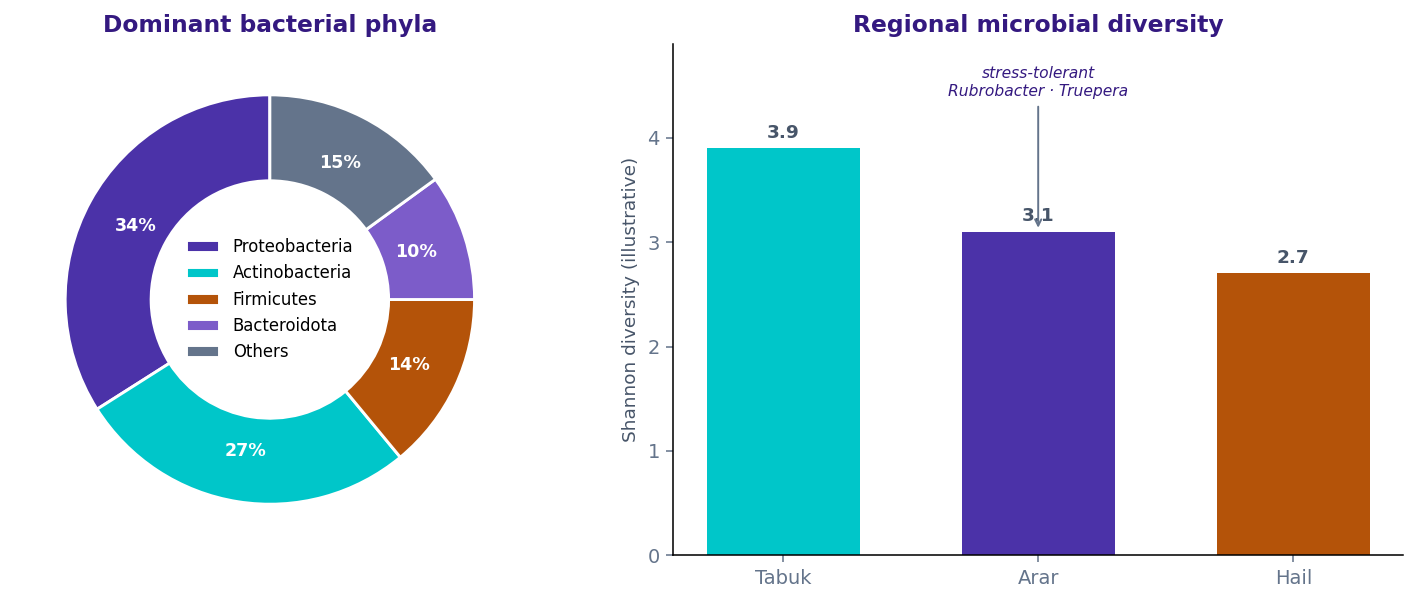
Across the sampled communities, two bacterial groups dominated: Proteobacteria and Actinobacteria. That is a signature worth noting — Actinobacteria in particular are renowned for producing stress-protective compounds and secondary metabolites, and their prominence here reflects the demands of life under heat, drought and high UV. These are not random assemblages; they are communities shaped by the pressures of the environment they inhabit.
Geography beats botany
Perhaps the most striking finding is what shapes these communities most strongly. It was not the plant species — it was the environment. Regional conditions had a greater influence on microbial community structure than which of the three plants a microbe was associated with. The Tabuk region hosted the greatest overall microbial diversity, while the Arar region contained distinctive stress-tolerant taxa, including Rubrobacter and Truepera — genera known for extreme resistance to radiation and desiccation.
Why desert microbes matter
Understanding how microbial communities survive extreme aridity is more than an academic curiosity. These organisms are a reservoir of adaptations relevant to environmental microbiology, biotechnology, sustainable agriculture and climate adaptation — from drought-tolerance traits that could support crops in marginal land, to novel enzymes and metabolites from extremophile bacteria. As the Kingdom advances its environmental and food-security goals, the desert microbiome is a genuinely strategic natural resource.
Embryo's take
We highlight this work because it sits at the intersection of everything we care about: Saudi biodiversity, genomics, and the practical value of characterising life at the molecular level. Rhizosphere and endophyte community profiling — whether by 16S amplicon surveys or shotgun metagenomics — is exactly the kind of environmental-genomics capability that turns a landscape into data, and data into applications for agriculture, conservation and biotechnology in the Kingdom.
Explore the full platform data, publications, and research tools:
Explore Environmental Genomics →