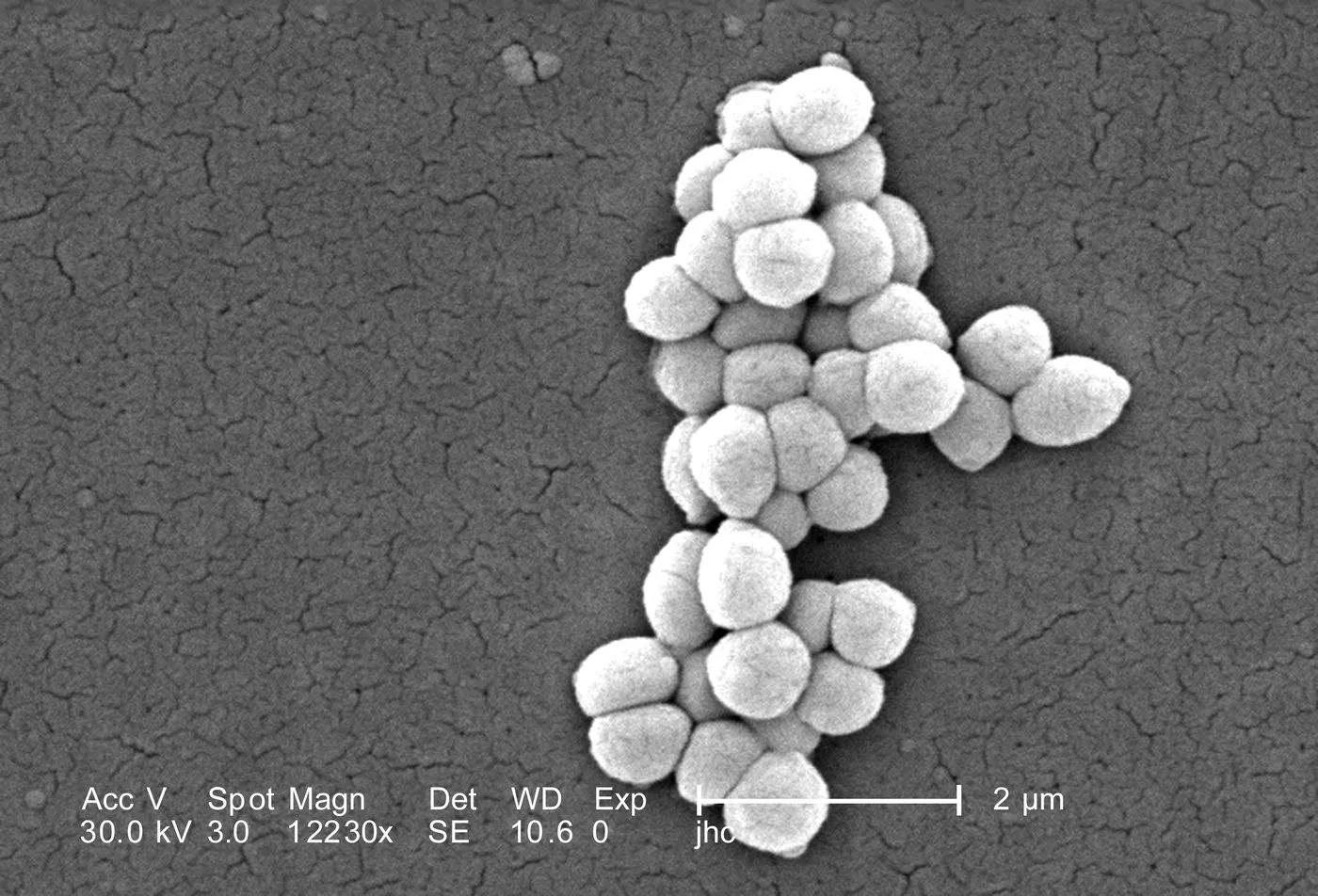
A Bacterium With No Name: Embryo's Pipeline Flags a Likely New Arthrobacter Species
Embryo's bacterial WGS pipeline sequenced isolate ProjectADD-10, a putative new Arthrobacter species. BUSCO 99.2%, four converging taxonomic methods, zero AMR.
How do you know if a bacterium is a brand-new species? Modern microbial taxonomy demands several independent methods to agree. Embryo's bacterial WGS pipeline ran four of them on isolate ProjectADD-10 — and all four agreed that this bacterium doesn't match any species ever named. It belongs to the genus Arthrobacter (Actinomycetota), is environmental and non-pathogenic, and is ready for formal description.
Why this matters
Species discovery is the daily output of strong microbial genomics labs. It's not glamorous — most novel species are harmless environmental organisms — but it is the engine behind every food-safety audit, every clinical microbiology investigation, and every bioprospecting programme for industrial enzymes. ProjectADD-10 is the showcase: it demonstrates that Embryo's pipeline meets the standards a peer-reviewed journal will demand, and that the same pipeline can be deployed at scale for clients across the Kingdom.
Abstract
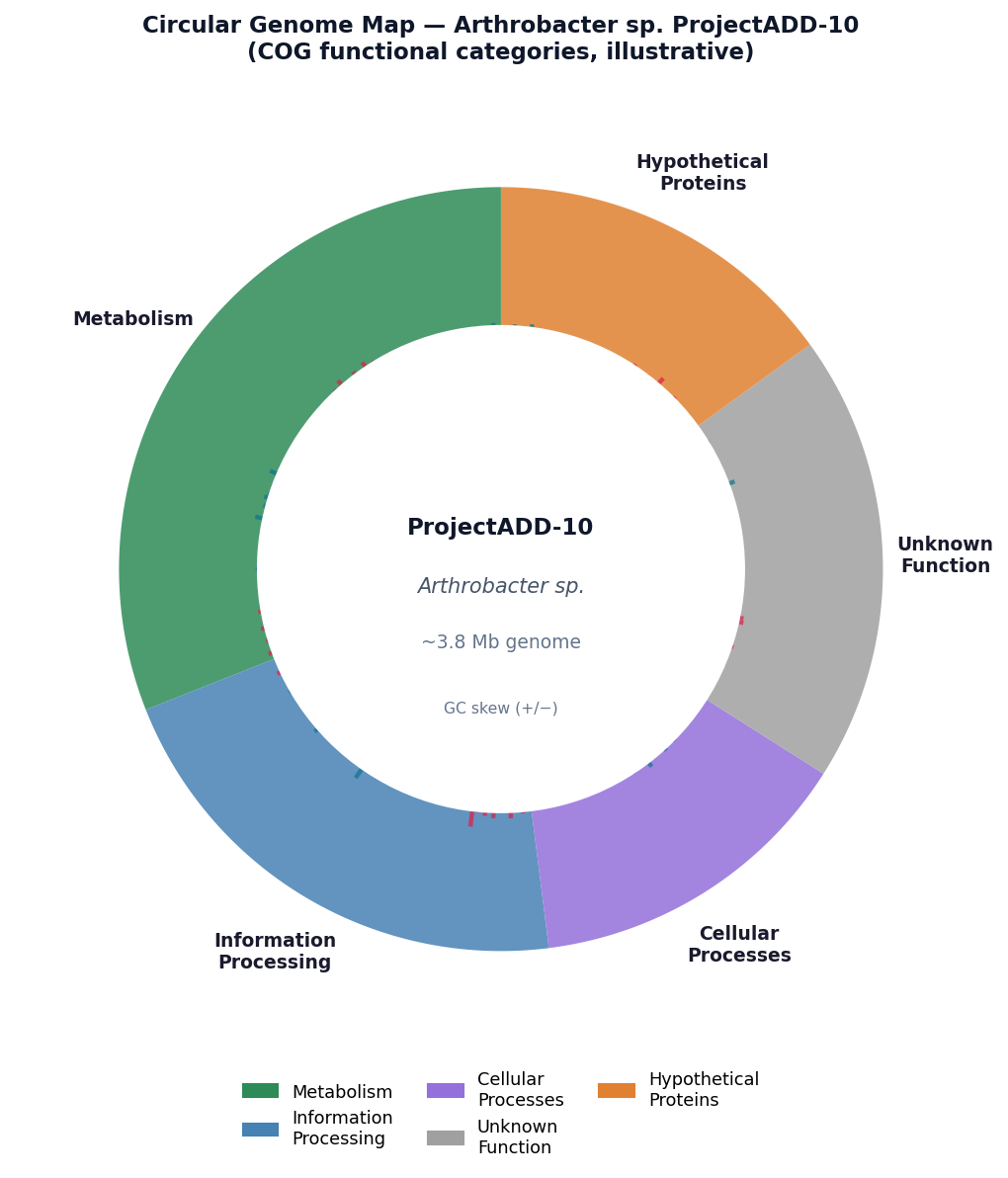
The genus Arthrobacter (family Micrococcaceae, phylum Actinomycetota) comprises environmentally widespread high-GC bacteria. The agilis / ruber / burdickii clade — designated Arthrobacter_D in the GTDB — remains particularly under-sampled. We sequenced isolate ProjectADD-10 on an Illumina NovaSeq platform (2 × 145 bp; ~357× depth). Assembly with SPAdes v4.2.0 produced 15 contigs totalling 3.514 Mb (N50 = 482 kb, L50 = 3, GC = 68.18%) with BUSCO bacteria_odb10 completeness of 99.2%. Prokka annotated 3,242 CDS. Taxonomic classification was triangulated by 16S BLAST, Kraken2, fastANI, and GTDB-Tk v2.5.2: GTDB-Tk assigned the genome to family Micrococcaceae, genus Arthrobacter_D, with the species field empty; fastANI peaked at 85.6% (well below the 95% species boundary). MLSA phylogeny placed ProjectADD-10 sister to the A. pityocampae + A. ruber clade (UFBoot 92.1). Zero hits across five AMR/virulence/plasmid screens. ProjectADD-10 represents a putative novel Arthrobacter_D species with a non-pathogenic environmental profile; formal description by TYGS digital DNA-DNA hybridisation is recommended.
Methods
Isolate ProjectADD-10 was sequenced on an Illumina NovaSeq instrument as a 2 × 145 bp paired-end library, producing 6,542,838 paired reads (1.79 Gb; ~357× on a 5-Mb expectation). Quality control used FastQC and MultiQC. Assembly used SPAdes v4.2.0 in --isolate --cov-cutoff auto mode. Assembly quality was assessed with QUAST 5.3.0 and BUSCO 6.0.0 against bacteria_odb10. Three small human-contaminating contigs (3 kb total) were removed. Annotation used Prokka v1.14.6; rRNA recovery used barrnap 0.9. Taxonomic classification used four independent methods: 16S BLAST against NCBI 16S Microbial, Kraken2 against the Standard database, fastANI against 13 reference Arthrobacter genomes, and GTDB-Tk v2.5.2 against GTDB r226. Phylogenetics used IQ-TREE 2 on a partitioned MLSA alignment of seven markers. Safety screens were run with abricate v1.0.1 against five databases, RGI on CARD 2023, AMRFinderPlus, and MOB-suite.
Results
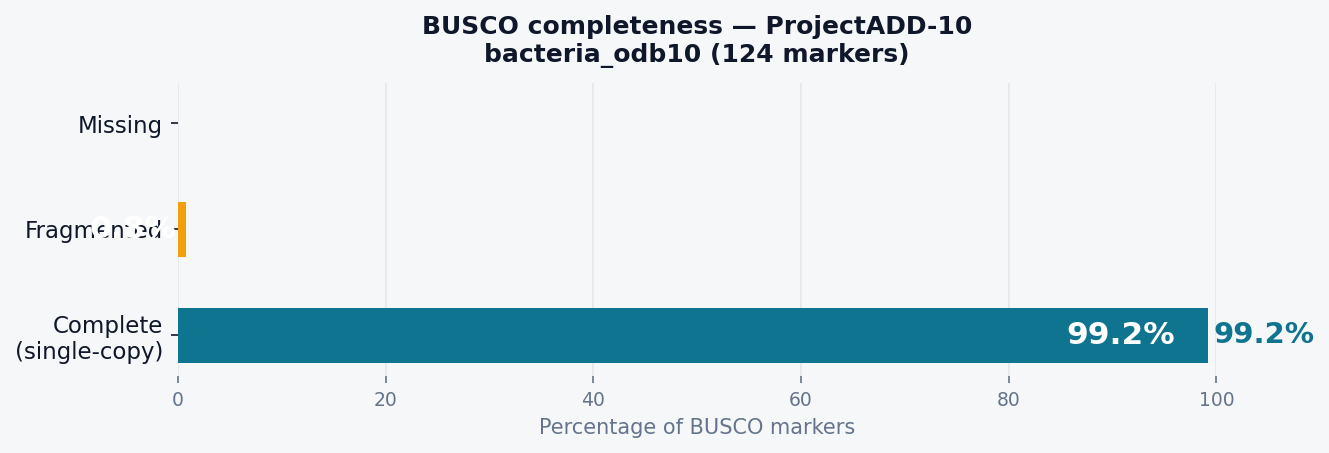
The Illumina NovaSeq run produced 13.09 million reads (1.79 Gb) at GC = 67%. Assembly yielded 15 contigs totalling 3.514 Mb with N50 = 482 kb and L50 = 3. BUSCO bacteria_odb10 completeness reached 99.2% (single-copy; 0% duplicated; 1 fragmented marker out of 124). Prokka annotated 3,242 CDS, 47 tRNAs, and a complete 16S/23S/5S rRNA operon. The four taxonomic methods converged on the same conclusion: 16S BLAST placed the genome firmly in genus Arthrobacter (top hits A. cheniae, A. bussei, A. agilis, A. ruber at 99.5–99.7% identity); GTDB-Tk assigned family Micrococcaceae, genus Arthrobacter_D, empty species field; fastANI peaked at 85.6% to the unnamed A._D sp004001285 — below the 95% species threshold by a clear margin; MLSA phylogeny placed ProjectADD-10 sister to the A. pityocampae + A. ruber clade with UFBoot 92.1. All five safety screens returned zero hits — no AMR, no virulence, no plasmid replicons.
What comes next — formal species description
The remaining step is formal validation via TYGS (Type Strain Genome Server) digital DNA-DNA hybridisation. With that, the strain can be deposited in a culture collection and receive a Latin binomial under the standards of the International Journal of Systematic and Evolutionary Microbiology (IJSEM). The genome is publication-ready as a Microbiology Resource Announcements 'genome announcement' in the interim — a fast format with strong DOI authority.
Have a bacterial isolate that needs a publication-grade workup? Embryo's bacterial WGS pipeline delivers a manuscript-ready dossier — assembly, taxonomy by four converging methods, MLSA phylogeny, and full safety screening.
Learn more →