From Reads to Answers: A Whole-Genome Workup of Salmonella Agona
A single-isolate demonstration of Embryo's end-to-end bacterial WGS service — from raw Illumina reads to serotype, sequence type, a multidrug-resistance profile, plasmid content and virulence, all in one interpreted report.
What does a complete bacterial whole-genome workup actually deliver? To show it end to end, we ran a demonstration report on a single Salmonella enterica serovar Agona isolate (sample SAL8) through Embryo's clinical and food-safety genomics pipeline — the same validated path every client isolate follows, from raw Illumina reads to an interpreted document covering identity, resistance, mobility and virulence. (This is an illustrative sample; real client reports are delivered securely and confidentially.)
High-depth sequencing, a complete genome
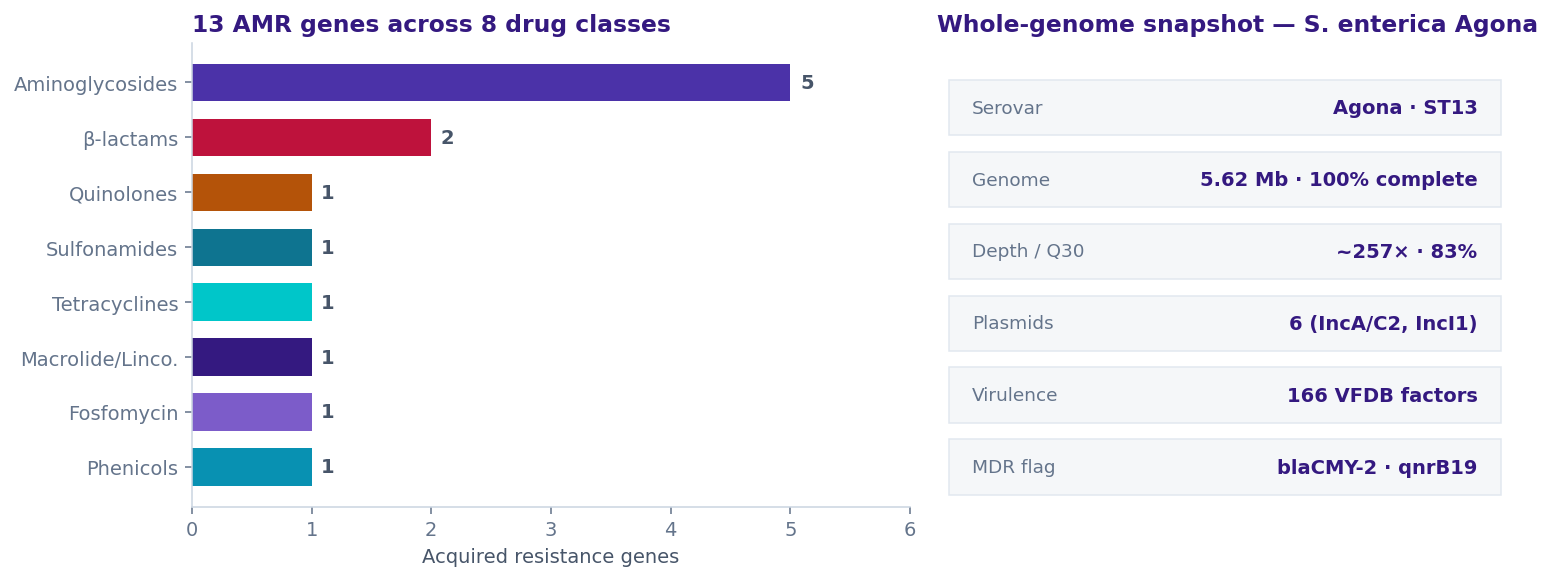
The foundation of every downstream call is a clean assembly. From 10.55 million raw read pairs, 94.8% passed quality control (fastp, FastQC) to give roughly 257× depth at 83% Q30. De-novo assembly (SPAdes, QUAST, CheckM2) produced a 5.62 Mb draft genome with 51.5% GC, an N50 of 149 kb, 100% completeness and only 0.44% contamination — comfortably above the thresholds needed for confident serotyping and resistance-gene calling.
Identity, confirmed three independent ways
Serovar identification should never rest on a single method. Genomic serotyping (SeqSero2), cgMLST-based prediction (SISTR) and classical 7-gene MLST all converged on the same answer: Salmonella Agona, serogroup B, sequence type ST13, with the antigenic formula 1,4,[5],12 : f,g,s : 1,5. The cgMLST profile matched 329 of 330 reference alleles — a high-confidence, surveillance-ready identification that can be traced against national and global outbreak databases.
A multidrug-resistant genotype worth flagging
Thirteen acquired resistance genes were detected across eight antimicrobial classes (AMRFinderPlus, ABRicate) — a multidrug-resistant (MDR) genotype of direct stewardship relevance. The profile includes an AmpC beta-lactamase (blaCMY-2) conferring 3rd-generation cephalosporin resistance, a TEM-1 penicillinase, and a plasmid-mediated quinolone-resistance gene (qnrB19), alongside five aminoglycoside determinants and single genes for sulfonamide, tetracycline, macrolide, fosfomycin and phenicol resistance. Genotype predicts resistance potential; phenotypic susceptibility testing remains the confirmatory standard.
How resistance travels — plasmids and co-selection
Mobile genetic elements explain how an isolate can spread its resistance. Six plasmid replicons were detected, including the broad-host-range conjugative backbones IncA/C2 and IncI1 — both frequently associated with the dissemination of blaCMY-2. The genome also carried tolerance determinants for mercury, arsenic, copper and quaternary-ammonium disinfectants. Co-location of metal and biocide tolerance with antibiotic-resistance genes can drive co-selection, meaning resistance is retained even under non-antibiotic pressure such as routine disinfection.
A fully pathogenic profile — and why it matters
Screening against the VFDB virulence database returned 166 factors, including the type III secretion machinery of Salmonella pathogenicity islands SPI-1 and SPI-2 (sopB, sopE2, sseJ, sifB), the SPI-4 adhesin siiE, and multiple fimbrial and adhesin clusters — the repertoire of an invasive, host-adapted pathogen capable of host-cell invasion and intracellular survival. Combined with the MDR genotype, this is exactly the kind of profile that warrants attention in both clinical management and outbreak surveillance. That is the point of the workup: identity confirmed three ways, an actionable resistance profile, the mechanism of spread, and surveillance-ready cgMLST data — one isolate, one interpreted report.
Explore the full platform data, publications, and research tools:
Request Bacterial WGS →