Decoding the Genetic Identity of Saudi Arabia's Local Chicken Breed
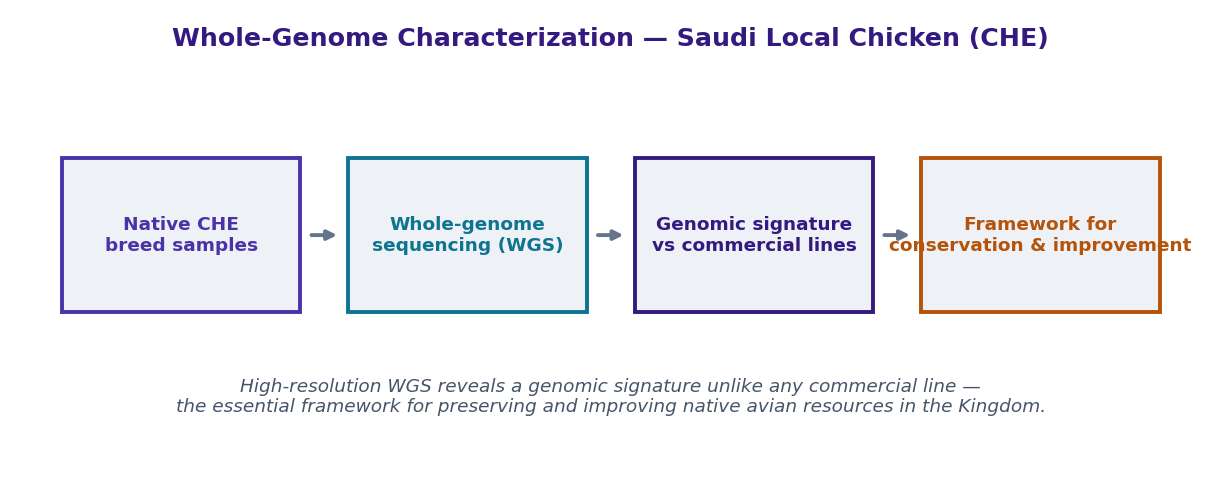
Whole-genome sequencing gives the Saudi local chicken breed (CHE) a high-resolution genomic identity — revealing a signature unlike any commercial line and providing the essential framework for preserving and improving the Kingdom's native avian resources.
Native livestock breeds are living genetic archives — shaped by centuries of adaptation to local climate, disease and husbandry. Yet without a molecular description, that heritage is invisible and vulnerable. Embryo applied whole-genome sequencing (WGS) to the Saudi local chicken breed, known as CHE, to give it something it never had before: a high-resolution genomic identity.
A genomic signature unlike any commercial line
The headline result is clear — WGS analysis revealed a genomic signature for the local Saudi chicken (CHE) that is distinct from commercial broiler and layer lines. That distinctiveness is precisely what makes native breeds valuable: they carry combinations of variants, adaptations and diversity that intensive commercial selection has narrowed or erased elsewhere. Characterising that signature at whole-genome resolution is the first step to protecting it.
From reads to a conservation framework
Whole-genome sequencing does more than confirm identity. The same data underpin population-structure analysis, inbreeding assessment, patterns of linkage disequilibrium, and the detection of positive-selection signatures — the genomic footprints of the traits that adaptation has favoured in the breed. Together these turn a poorly documented local population into a well-characterised genetic resource with a clear baseline against which future change can be measured.
Why native avian resources matter
Preserving indigenous breeds is both a biodiversity priority and a food-security one. Locally adapted chickens can offer resilience to heat and regional disease pressures that commercial lines lack — traits that become more valuable, not less, under a changing climate. A genomic framework lets breeders make informed decisions: conserving diversity, avoiding inbreeding, and improving the breed on its own genetic terms rather than diluting it with imported stock.
The bigger picture
This work provides the essential genomic framework needed for the preservation and improvement of native avian resources in the Kingdom — and it sits alongside Embryo's broader animal-genomics portfolio spanning camels, sheep and other indigenous species. Building sovereign genomic references for Saudi livestock is a long-term investment in biodiversity, food security and Vision 2030's sustainability goals.
Explore the full platform data, publications, and research tools:
Request Animal Genomics →