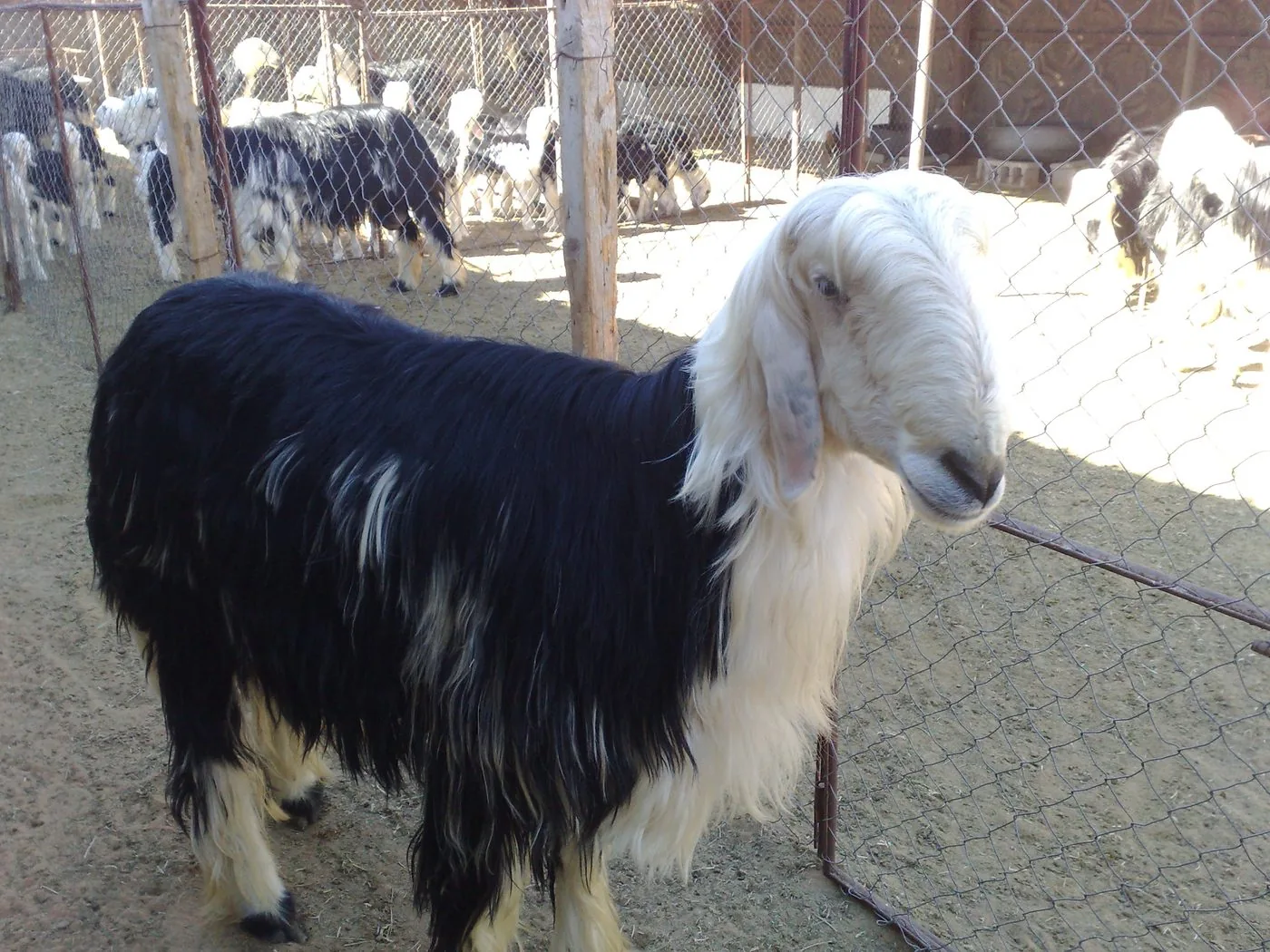
Saudi Arabia Local Sheep Population Genomics
First genome-wide OvineSNP50 analysis of Saudi indigenous sheep: Najdi shows alarming inbreeding (F_ROH=0.053, Ne=3.30) vs Naemi and Harri. Published Frontiers in Genetics 2025.
For the first time, all three major indigenous Saudi sheep breeds — Najdi, Naemi, and Harri — have been analysed together in a single genome-wide SNP study. The results are striking: the Najdi, prized across the Arabian Peninsula for its distinctive long coat and cultural prestige, is in a state of advanced genetic isolation with an effective population size of just 3.30 individuals and an inbreeding coefficient (F_ROH) of 0.053 — the highest of any breed in the study. This work, published in Frontiers in Genetics (2025), provides the first genomic baseline for evidence-based conservation and selective breeding of Saudi indigenous livestock.
Study Design
A total of 95 sheep belonging to three Saudi indigenous breeds were genotyped using the Illumina OvineSNP50 BeadChip: Najdi (n=33), Naemi (n=24), and Harri (n=38). After quality control in GenomeStudio v2.0.5 and PLINK v1.9 — removing SNPs with call rate <95%, MAF <0.01, and individuals with missing genotype rates >5% — 34,026 high-quality autosomal SNPs were retained from an initial panel of 64,734 markers. Downstream analyses included runs of homozygosity (ROH), identity by descent (IBD) using Refined IBD v4.1 and Beagle v4.1, admixture analysis (LEA package, R), phylogenetic network construction (SplitsTree CE 6.0.0), and effective population size estimation.
Population Structure and Genetic Differentiation
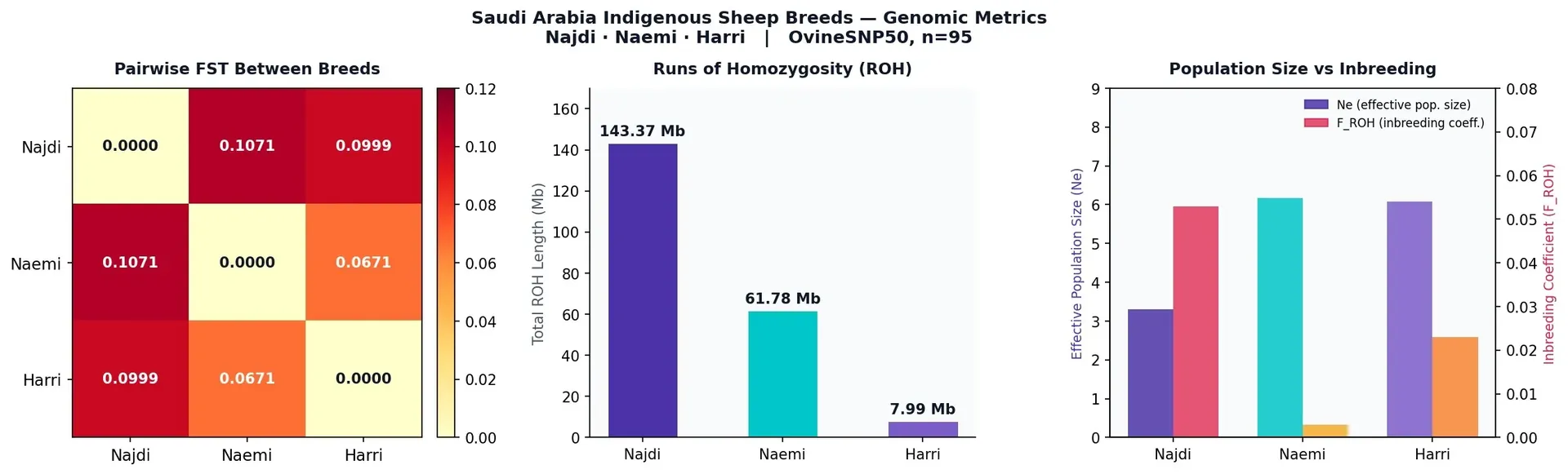
Pairwise FST values confirm that the Najdi is the most genetically isolated of the three breeds: FST = 0.1071 against Naemi and 0.0999 against Harri, compared to a more moderate FST = 0.0671 between Harri and Naemi. Admixture analysis assigned 92% of Najdi individuals to a single unique cluster — a hallmark of a closed, selectively managed population. Naemi showed 89.03% within-breed cluster assignment, while Harri displayed more admixture at 77.31%, consistent with its wider geographic distribution and less rigid selection history. A total of 336 breed-specific high-FST SNPs were identified across all pairwise comparisons, providing a candidate marker panel for breed authentication.
Inbreeding and Runs of Homozygosity
The most urgent finding concerns the Najdi's level of inbreeding. Total ROH length per individual reached 143.37 Mb in Najdi (mean 21.18 segments per individual), compared to 61.78 Mb in Harri (11.23 segments) and just 7.99 Mb in Naemi (1.96 segments). The inbreeding coefficient from ROH (F_ROH) follows the same rank order: Najdi 0.053, Harri 0.023, Naemi 0.003. The inbreeding coefficient from allele frequencies (F_IS) reinforces this — Najdi 0.092, Harri 0.027, Naemi −0.055 (the negative value indicating slight excess heterozygosity in Naemi, consistent with outbreeding). Long ROH segments (>10 Mb) are particularly prominent in the Najdi, indicating recent inbreeding rather than ancient bottleneck effects alone.
Effective Population Size and Genetic Diversity
The estimated effective population size (Ne) of the Najdi stands at 3.30 — a critically low figure that signals high vulnerability to the accumulation of deleterious alleles through genetic drift. By comparison, Harri (Ne = 6.08) and Naemi (Ne = 6.16) have roughly twice the effective size, though all three remain well below the threshold of 50 individuals commonly cited as the minimum viable Ne for conservation purposes. Observed heterozygosity (Ho) mirrors the inbreeding gradient: Naemi 0.371 > Harri 0.342 > Najdi 0.319. The proportion of fixed alleles (MAF = 0) is 9.92% in Najdi, 3.96% in Harri, and 1.24% in Naemi — further evidence of allelic erosion in the most isolated breed.
Conservation Implications
The Najdi's genetic profile — high FST, high F_ROH, low Ne, abundant fixed alleles, and long ROH segments — collectively indicate a breed at risk of inbreeding depression if no corrective management is applied. The study recommends: (1) establishment of a national genomic database for all Saudi sheep breeds using the OvineSNP50 panel as a minimum standard; (2) managed mate selection to minimise kinship among Najdi breeding pairs; (3) cryopreservation of germplasm from genetically diverse Najdi individuals as an insurance policy; and (4) monitoring of functional genomic regions within ROH segments to identify any signatures of selection that should be preserved versus regions carrying putative deleterious loads. The 336 breed-diagnostic SNPs identified here are immediately applicable for breed identity verification in official livestock registration systems.
Significance for Vision 2030 and Saudi Livestock Strategy
The Najdi sheep occupies a uniquely prominent cultural and economic role in Saudi Arabia — featured in heritage festivals, high-value auctions, and artisanal textile production. The National Agricultural Development Strategy under Vision 2030 explicitly targets improvement of indigenous livestock breeds to secure food sovereignty. This study delivers the first objective genomic data to support that goal: a breed-level SNP baseline, quantified inbreeding levels, and a set of breed-specific markers that enable the transition from phenotypic to genomic-assisted selection. Embryo Co. contributed bioinformatics analysis to this work and continues to develop its animal genomics pipeline — including whole-genome sequencing services — for application to Saudi livestock species.
Interested in genomic characterisation of your livestock breeds? Contact Embryo for WGS and SNP array services.
Learn more →