109 Biosynthetic Gene Clusters: Embryo's Streptomyces Natural-Product Catalogue
Embryo identified 109 biosynthetic gene clusters across three Streptomyces isolates with 89% multi-tool validation. A Saudi-led natural-product discovery resource.
Streptomyces — filamentous soil bacteria of the phylum Actinomycetota — are the producers of more than two-thirds of clinically used natural-product antibiotics. With antimicrobial resistance rising and the antibiotic pipeline slowing, Streptomyces genome mining is the front line of new natural-product discovery. In partnership with Dr Nada Al-Theyab, Embryo characterised three Streptomyces isolates and built a multi-tool-validated catalogue of 109 biosynthetic gene clusters — 3.6 Mb of biosynthetic DNA — ready for downstream natural-product chemistry.
Why a BGC catalogue is a strategic asset
The Saudi National Biotechnology Strategy explicitly identifies biomanufacturing and therapeutics as priority areas. Antibiotic discovery is one of the highest-value scientific frontiers in the world. Streptomyces genomes encode dozens of biosynthetic gene clusters apiece — many of them cryptic and uncharacterised. A validated catalogue is the front door to natural-product chemistry: heterologous expression, structural characterisation, and bioactivity screening all start from a list of candidate clusters.
Abstract
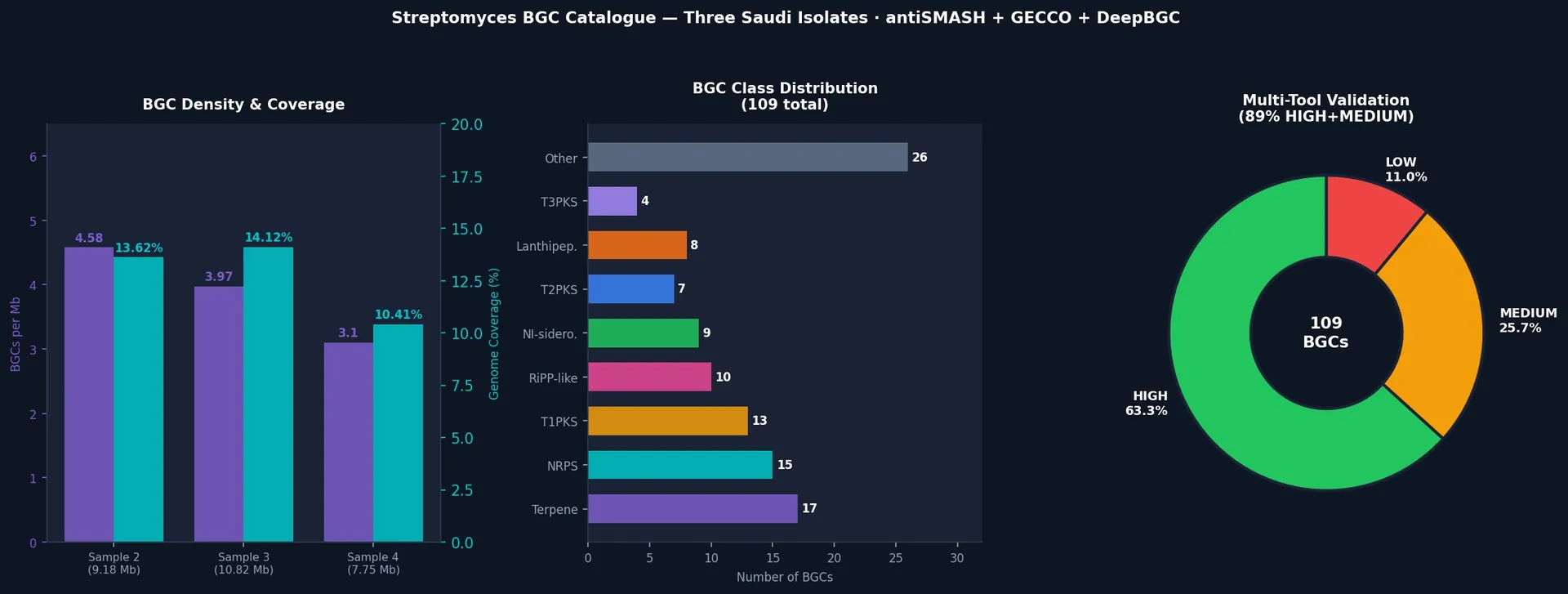
Three Streptomyces isolates were sequenced on an Illumina NovaSeq platform and assembled to draft genomes (7.75–10.82 Mb). BGCs were predicted with antiSMASH 7.0 and orthogonally validated with GECCO and DeepBGC using a 50% reciprocal overlap threshold. A total of 109 BGCs were identified across the three genomes: sample 2 — 42 regions (4.58/Mb; 13.62% coverage); sample 3 — 43 regions (3.97/Mb; 14.12% coverage); sample 4 — 24 regions (3.10/Mb; 10.41% coverage). Predicted BGCs spanned 3.7–163.6 kb (median 23.5 kb; mean 32.9 kb). The most abundant classes were terpenes (n=17), NRPS (n=15), and T1PKS (n=13), with 22 hybrid multi-class clusters (20.2%), including an exceptionally large 163.6 kb 5-class region in sample 3 (NRPS + T1PKS + terpene precursor + NRP-metallophore + NRPS-like). Multi-tool validation yielded 69 HIGH-confidence regions (63.3%), 28 MEDIUM (25.7%), and 12 LOW (11.0%) — 89.0% total validated. GECCO confirmed 75.2% of antiSMASH predictions; DeepBGC confirmed 77.1%. The validated regions total 3.6 Mb of biosynthetic DNA — a substantial catalogue for natural-product discovery.
Methods
Three Streptomyces isolates were sequenced on Illumina NovaSeq paired-end libraries and assembled to draft genomes. BGCs were predicted with antiSMASH 7.0 at default thresholds. Orthogonal validation used GECCO (Gene Cluster prediction with Conditional random fields) and DeepBGC (deep-learning BGC detection). Cluster matching across tools used a 50% reciprocal overlap threshold. Confidence tiers were defined as: HIGH (both tools confirm the antiSMASH prediction); MEDIUM (one tool confirms); LOW (no independent confirmation).
Results
Per-isolate metrics — sample 2: 9.18 Mb genome, 42 BGCs, 4.58 BGCs/Mb, 13.62% genome coverage, 1.25 Mb BGC DNA; sample 3: 10.82 Mb, 43 BGCs, 3.97/Mb, 14.12% coverage, 1.53 Mb BGC DNA; sample 4: 7.75 Mb, 24 BGCs, 3.10/Mb, 10.41% coverage, 0.81 Mb BGC DNA. Cohort total: 109 BGCs, 3.6 Mb biosynthetic DNA, mean 3.88 BGCs/Mb. BGC class distribution: terpene (17; 15.6%), NRPS (15; 13.8%), T1PKS (13; 11.9%), RiPP-like (10; 9.2%), NI-siderophore (9; 8.3%), terpene precursor (9; 8.3%), lanthipeptide classes (8; 7.3%), T2PKS (7; 6.4%), T3PKS (4; 3.7%). Hybrid multi-class clusters: 22 regions (20.2%). Bioactive-architecture clusters (NRPS / PKS / RiPP / siderophore): 62 regions (56.9%). The largest cluster is a 163.6 kb 5-class hybrid in sample 3 (NRPS + T1PKS + terpene precursor + NRP-metallophore + NRPS-like). Multi-tool validation: 69 HIGH (63.3%), 28 MEDIUM (25.7%), 12 LOW (11.0%); 97 (89%) of 109 BGCs are HIGH+MEDIUM validated. GECCO confirmed 75.2%; DeepBGC confirmed 77.1%; GECCO-unique 13, DeepBGC-unique 15. LOW-confidence is enriched for RiPP-like (4/12) and hydrogen-cyanide (3/12) classes — candidates for targeted experimental verification.
What this catalogue unlocks
The 97 HIGH+MEDIUM-confidence BGCs are an immediate target list for heterologous expression, structural elucidation, and bioactivity screening. The 163.6 kb 5-class hybrid is a particularly interesting candidate — multi-class hybrid clusters often encode novel scaffolds that are difficult to predict computationally. The full BGC catalogue is also a foundation for comparative work: as more Saudi Streptomyces isolates are sequenced, the pan-BGC profile of Saudi soil microbiology will become a sovereign biotech asset.
Have actinomycete isolates with natural-product potential? Embryo delivers a 3-tool validated BGC catalogue — ready for heterologous expression and bioactivity screening.
Learn more →