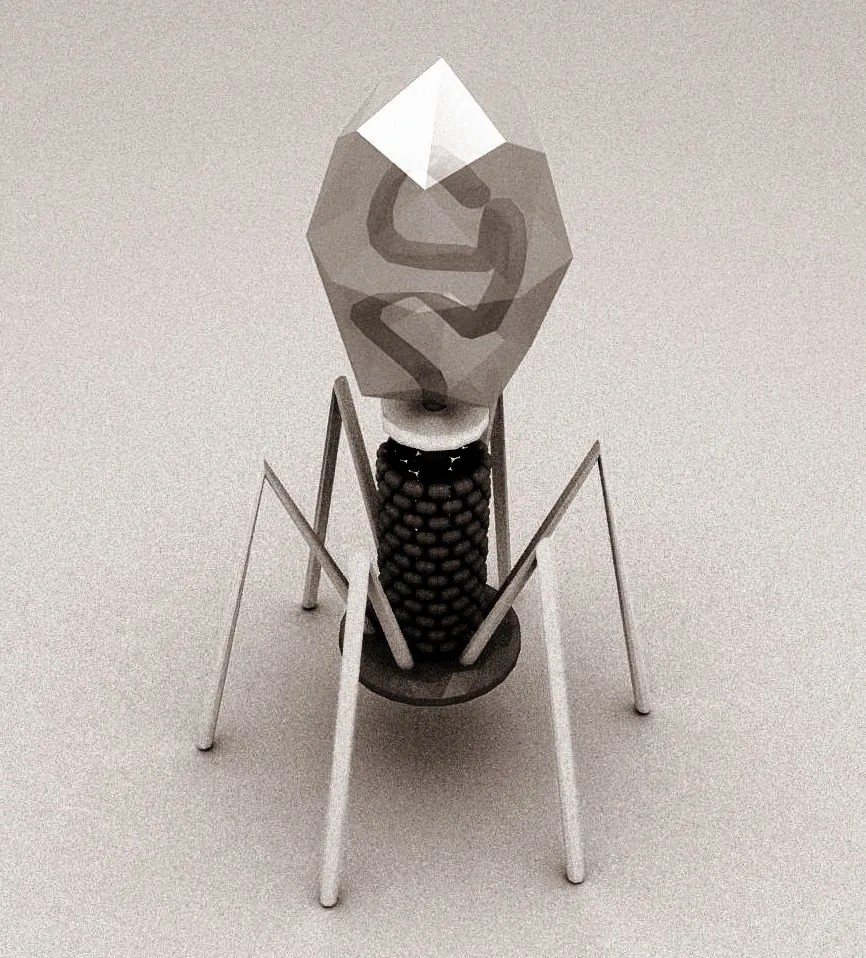
A Saudi-Sequenced Phage That Kills Superbugs: Tequatrovirus pss1 PH-1
Embryo sequenced and characterised bacteriophage PH-1, a strictly lytic Tequatrovirus pss1 with zero AMR or virulence cargo — a phage therapy candidate against E. coli and Shigella.
Antimicrobial resistance is one of the World Health Organisation's top global health threats. While antibiotics increasingly fail, bacteriophages — viruses that kill bacteria — are returning to clinical and food-safety pipelines worldwide. Embryo, in partnership with Dr Asma Al Salih, sequenced and characterised one such phage to publication grade: PH-1 is a complete, strictly lytic Tequatrovirus pss1 isolate with zero resistance, virulence, or plasmid cargo — a clean candidate for therapy and biocontrol against Escherichia coli and Shigella.
Why phages now
Phages are exquisitely specific — most attack only a narrow range of bacteria, leaving the patient's microbiome and the environment largely untouched. Modern sequencing and bioinformatics make it possible to characterise a phage's safety profile to publication grade in days. Saudi Arabia is in a strong position: the National Biotechnology Strategy explicitly targets innovation in therapeutics and biomanufacturing, and food security is a national priority. A clean, locally characterised phage genome is a foundation stone for both.
Abstract
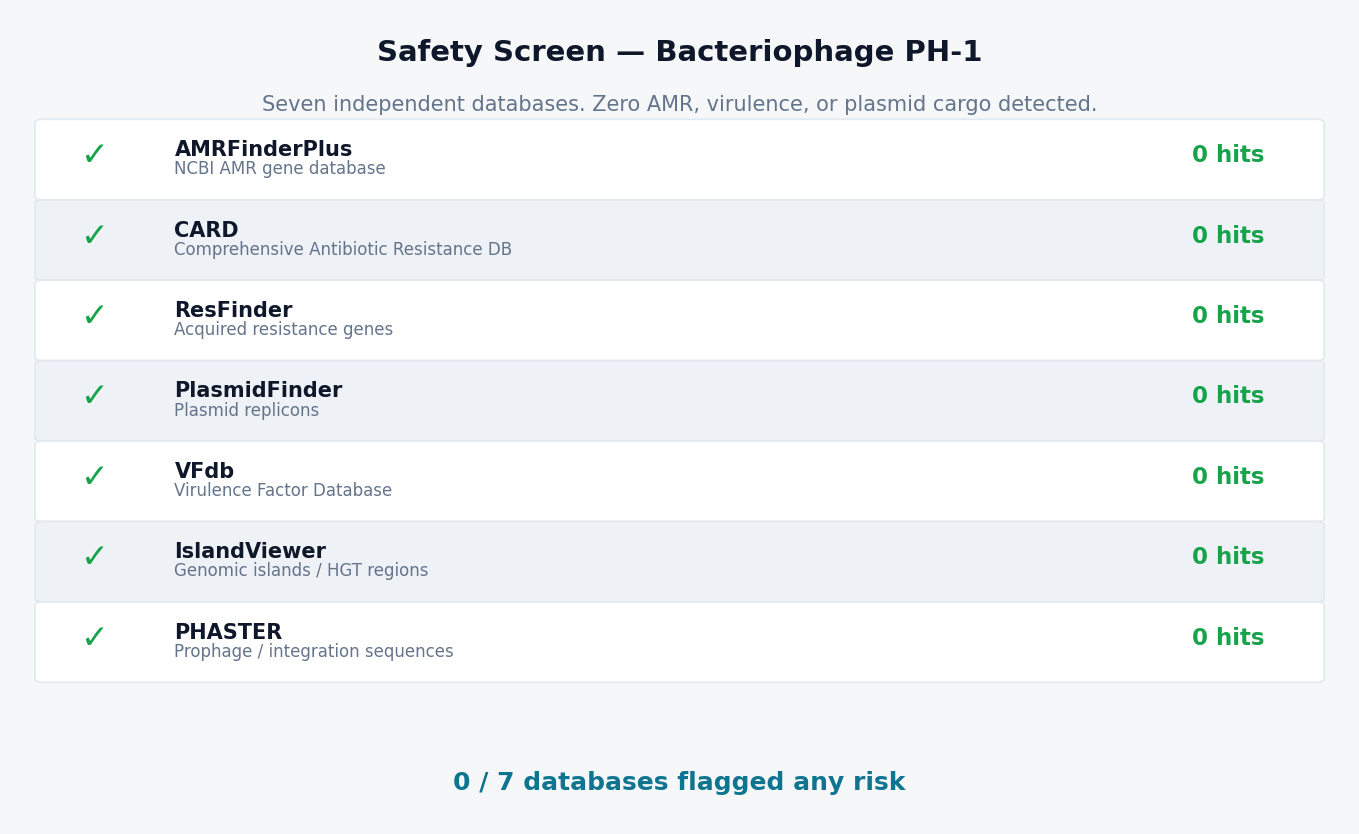
Background. Bacteriophages of the genus Tequatrovirus (family Straboviridae, subfamily Tevenvirinae) are large, strictly lytic, T4-like viruses that target Escherichia coli, Shigella spp., and other Enterobacteriaceae. Methods. A bacteriophage isolate (PH-1) was sequenced on an Illumina NovaSeq platform (2 × 143 bp paired-end). 5.79 M read pairs (Q30 = 99%; GC = 36%) were sub-sampled to 10%, assembled with SPAdes v3.15, and assessed with QUAST and CheckV v1.1. Taxonomic placement combined Kraken2, skani v0.3 ANI against 84 Tequatrovirus reference genomes, and BLASTn. Annotation used Pharokka v1.9 (PHROGs v4, PHANOTATE, tRNAscan-SE). Seven independent AMR/virulence/plasmid screens were run. Lifestyle was predicted with BACPHLIP v0.9, and IQ-TREE 2 was used for large-terminase phylogeny. Results. Assembly recovered a single 166,098 bp contig at 79× coverage. CheckV: Complete / High-quality MIUViG (100% completeness, 0% contamination, DTR detected). skani ANI to Shigella phage pSs-1: 98.27% — above the ICTV species threshold (95%), placing PH-1 in Tequatrovirus pss1. BACPHLIP: virulent probability 1.0. Zero AMR/virulence/plasmid hits across seven screens. Conclusion. PH-1 is a complete, strictly lytic Tequatrovirus pss1 with no toxin or resistance cargo — a favourable safety profile for downstream therapeutic or biocontrol development.
Methods
Phage isolate PH-1 was sequenced on an Illumina NovaSeq instrument as a 2 × 143 bp paired-end library (5,788,723 read pairs; 1.575 Gb; Q30 = 99%; GC = 36%). Because k-mer-based depth (~750×) exceeded the optimum for short-read viral assembly, reads were sub-sampled to 10% (578,076 pairs) prior to assembly with SPAdes v3.15 (--isolate --only-assembler). Viral completeness was assessed with CheckV v1.1; viral origin was confirmed with geNomad v1.12. Taxonomic placement used Kraken2 (k2_viral_20240904), skani v0.3 ANI against 84 NCBI RefSeq Tequatrovirus genomes, and BLASTn. Annotation used Pharokka v1.9. Seven safety screens were run: AMRFinderPlus v3.12, and abricate v1.0.1 against NCBI, CARD, ResFinder, ARG-ANNOT, EcoliVF, and PlasmidFinder. Lifestyle was predicted with BACPHLIP v0.9. Large-terminase (TerL) phylogeny used IQ-TREE 2 (MFP model selection; 1,000 UFBoot; 1,000 SH-aLRT).
Results
Assembly recovered a single 166,098 bp contig (NODE_1) at 79× mean k-mer coverage with N50 = 166,098 bp and GC = 35.5%. CheckV classified the contig as a Complete, High-quality MIUViG genome (100% completeness, 0% contamination, direct terminal repeats detected). Three independent lines of evidence converged on Tequatrovirus pss1: Kraken2 placed 91.92% of classified reads at genus Tequatrovirus; skani ANI to Shigella phage pSs-1 reached 98.27% (well above the 95% ICTV species threshold); the TerL phylogeny placed PH-1 within the Tequatrovirus clade. BACPHLIP predicted a strictly virulent lifestyle (probability 1.0). Zero acquired AMR genes, virulence factors, or plasmid replicons were detected across all seven independent screens. Annotation produced 283 coding sequences (96% coding density) and 9 tRNAs — the canonical T-even-like phage tRNA complement.
Why this matters
A clean phage characterisation is the entry ticket to therapeutic and food-safety pipelines. PH-1 hits every gate that a regulator or a downstream developer would ask for: complete genome, defensible species call, strict lytic lifestyle, no resistance or virulence cargo, no integration genes. The same workflow can be applied to other Saudi-isolated phages — and we are actively building that pipeline as a genomics characterisation service for public health agencies and food-safety programmes across the Kingdom.
Have a phage isolate that needs a publication-grade characterisation? Embryo runs the full safety, taxonomy, and lifestyle workup in-Kingdom.
Learn more →