
Active Research Projects
Embryo's bioinformatics and genomics team conducts end-to-end research across clinical genetics, conservation biology, drug discovery, and microbiology — generating publishable science from raw sequencing data to clinical or environmental impact.

Down Syndrome & Congenital Heart Disease
Oligogenic modifier architecture in DS-CHD
Combined whole-exome sequencing of 22 Down syndrome individuals (17 with CHD, 5 without) and whole-genome sequencing of a consanguineous family quartet revealed a compelling oligogenic model for cardiac defect penetrance in trisomy 21.
KEY FINDINGS
- ▸NOTCH1 emerged as top candidate (evidence score 8/10) — homozygous p.Asp1698Ala variant
- ▸Compound heterozygous HCN4 variants identified (cardiac pacemaker channel disruption)
- ▸PRKCB and TBX20 identified as candidate protective factors
- ▸All 7 cardiac developmental pathways disrupted in both affected daughters
CAPABILITIES DEMONSTRATED
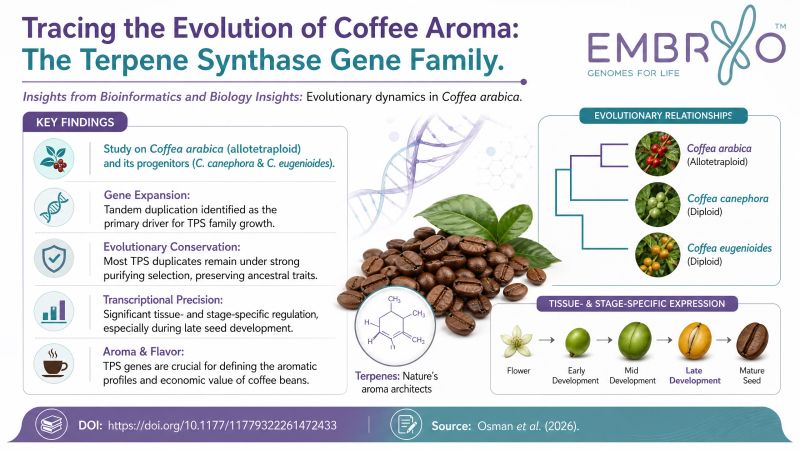
Domain-specific variants reshape terpene synthase conformational dynamics and ligand binding in Coffea arabica populations from Saudi Arabia
Saudi Coffea arabica WGS: how natural variants and lid architecture shape aroma-enzyme dynamics
Whole-genome sequencing of Saudi Arabian Coffea arabica found variants in five of 69 terpene synthase (TPS) genes. Modelling, docking and triplicate 300-ns molecular dynamics show that natural TPS variation can remodel catalytic-site dynamics while keeping the overall fold intact, and that the enzyme lid strongly controls how the ligand is held.
KEY FINDINGS
- ▸Variants in 5 of 69 TPS genes, including 8 missense substitutions in one TPS
- ▸p.Glu424Val keeps the global fold but alters ligand dynamics and Mg²⁺ coordination
- ▸The full 8-variant model partially restores catalytic coupling (directional, not statistically significant)
- ▸Lid-containing TPS holds the ligand more tightly (ligand RMSD 2.91 vs 4.17 Å; q = 0.011)
CAPABILITIES DEMONSTRATED

Whole-genome characterization and genomic stability of Mastadenovirus F40 and F41 in pediatric gastroenteritis
Pediatric stool shotgun metagenomics: hidden pathogens, AMR carriage & PCR blind spots
Shotgun metagenomics applied to 30 pediatric stool samples alongside multiplex PCR revealed clinically actionable findings the panel missed — including VRE in a neonate — and demonstrated strong age-dependent patterns in antimicrobial resistance carriage.
KEY FINDINGS
- ▸96.7% of samples yielded usable assemblies
- ▸Every sample carried ≥1 clinical pathogen after filtering
- ▸421 plasmid replicon hits across 60 unique plasmid types
- ▸Strong negative correlation: age vs. AMR carriage (ρ = −0.48, p = 0.009)
CAPABILITIES DEMONSTRATED

Najdi Pigeon Population Genomics
WGS-based breed differentiation in Saudi lineages
Whole-genome sequencing of 11 high-quality individuals across four Najdi pigeon lineages (SBB, WBB, WWB, Carrier) using a multi-method approach to resolve breed boundaries, admixture, and phylogenetic relationships in Saudi-native breeds.
KEY FINDINGS
- ▸Clear breed-level genetic differentiation confirmed across all 4 lineages
- ▸Maximum-likelihood phylogeny (IQ-TREE, GTR+F+G4+I) with 1000 UFBoot replicates
- ▸ADMIXTURE analysis revealed distinct ancestry proportions per lineage
- ▸IBS pairwise distances confirmed Carrier breed as genetically most distant
CAPABILITIES DEMONSTRATED
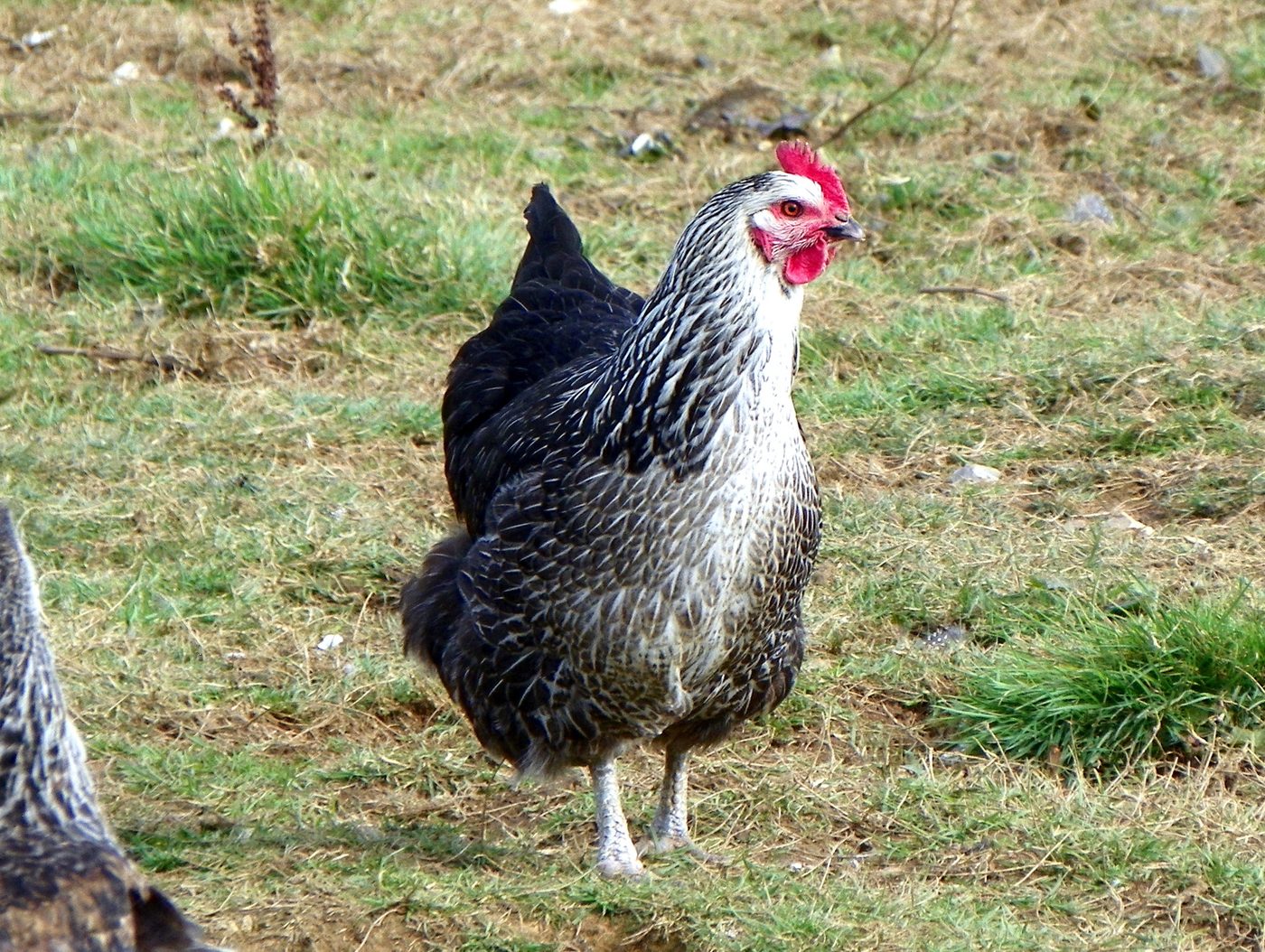
Saudi Local Chicken Breed (CHE) Genomics
Population structure, diversity & selection signatures
Comprehensive genomic characterization of the Saudi local chicken breed (CHE) compared to international reference breeds — mapping population structure, inbreeding, LD decay, effective population size, and positive selection signatures unique to this breed.
KEY FINDINGS
- ▸PCA and ADMIXTURE resolved CHE as a genetically distinct local breed
- ▸ROH analysis revealed inbreeding history — unique FROH signature
- ▸LD decay and effective population size (Ne) estimated from SNP data
- ▸Selection scan (CSS, π, Tajima's D) identified breed-specific sweep regions
CAPABILITIES DEMONSTRATED
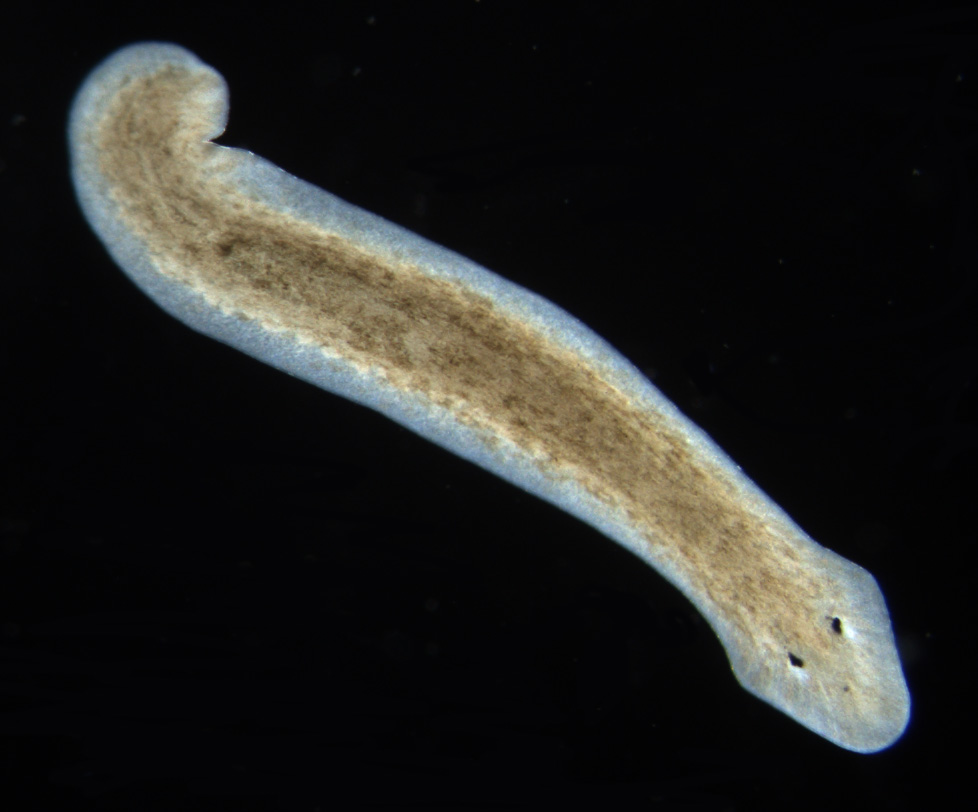
Dugesia arabica — Novel Planarian Genome
First genome of a Saudi-endemic regenerating flatworm
First genomic sequencing and characterization of Dugesia arabica — a novel planarian isolate endemic to the Al-Baha region of Saudi Arabia — establishing a genomic baseline for this regeneration model organism and confirming its placement within the Dugesia clade.
KEY FINDINGS
- ▸Draft assembly N50: 57.8 kb from ~3.6 Gb Illumina NovaSeq data
- ▸Complete 72-gene regeneration & stem cell toolkit annotated
- ▸Full Minichromosome Maintenance (MCM) complex identified
- ▸PIWI-1 gene: 92.8% amino acid identity with D. japonica
CAPABILITIES DEMONSTRATED
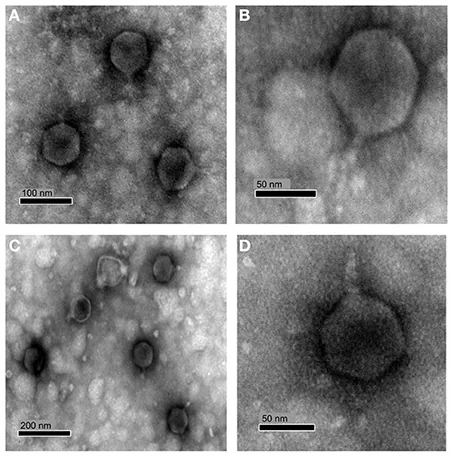
Bacteriophage I5 Whole-Genome Analysis
Salmonella phage genome characterization & safety profile
Whole-genome sequencing and complete characterization of bacteriophage I5 — a Salmonella-targeting phage classified in the Seunavirus genus (Vequintavirinae subfamily) — demonstrating a clean safety profile with no antibiotic resistance or virulence genes detected.
KEY FINDINGS
- ▸Total genome: ~134 kb across 3 main contigs, N50 = 91,279 bp
- ▸Taxonomic assignment: Seunavirus genus, Vequintavirinae subfamily
- ▸Closest neighbor: Salmonella phage (BLASTn/INPHARED database)
- ▸No antibiotic resistance genes detected (CARD / ABRicate screening)
CAPABILITIES DEMONSTRATED

Novel Biosynthetic Gene Cluster Discovery
Antibiotic candidate mining from Saudi Streptomyces isolates
Subtractive genome mining of three Streptomyces isolates against reference genomes identified 70 biosynthetic gene clusters (BGCs), with 8 highly novel candidates (TIER1, <30% MIBiG similarity) representing entirely uncharacterized potential antibiotic compound classes.
KEY FINDINGS
- ▸70 total BGCs identified across three isolates
- ▸8 TIER1 highly novel BGCs — no close match in known compound databases
- ▸8 TIER2 novel BGCs — distant from known clusters
- ▸Isolate 3 most productive: 43 unique BGCs including 7 TIER1 candidates
CAPABILITIES DEMONSTRATED
CRISPR gRNA Design — Coffee86
Computational guide RNA design and off-target analysis
Computational CRISPR-Cas9 guide RNA (gRNA) design pipeline for the Coffee86 target, encompassing on-target efficiency scoring, off-target prediction across the reference genome, and ranked gRNA candidate selection for experimental validation.
KEY FINDINGS
- ▸Complete gRNA candidates designed for all target sites
- ▸Off-target prediction across full reference genome
- ▸On-target efficiency scoring (Rule Set 2 / Azimuth criteria)
- ▸GC content, secondary structure, and PAM compatibility assessed
CAPABILITIES DEMONSTRATED
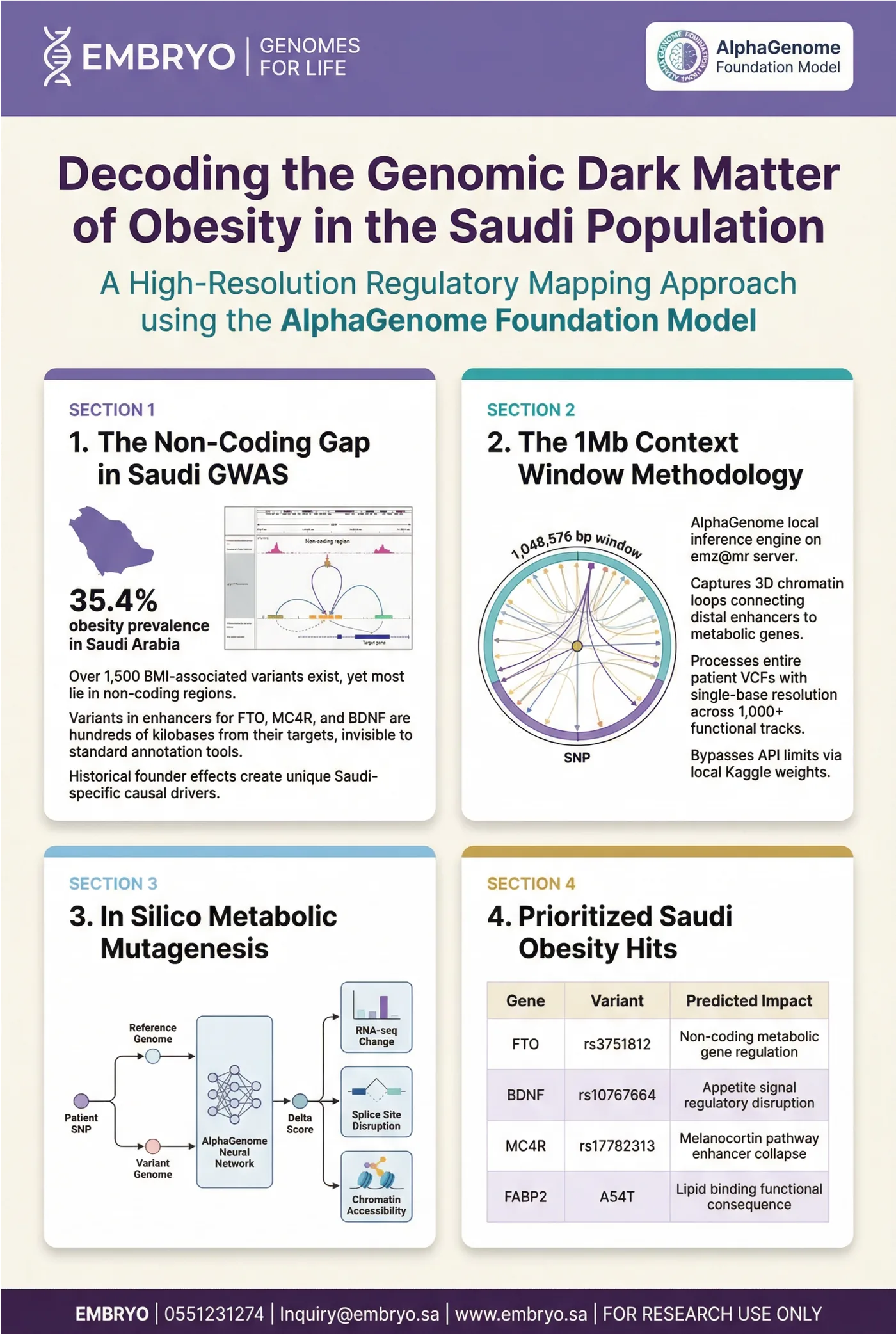
Saudi Obesity GWAS — AlphaGenome Foundation Model
Decoding the genomic dark matter of obesity in the Saudi population
High-resolution regulatory mapping of 1,500+ BMI-associated variants in the Saudi population using the AlphaGenome Foundation Model — addressing the "non-coding gap" where most GWAS hits lie in regulatory regions invisible to standard annotation, with a 1Mb context window approach capturing 3D chromatin interactions.
KEY FINDINGS
- ▸35.4% obesity prevalence in Saudi Arabia — most variants in non-coding regions
- ▸FTO rs3751812: non-coding metabolic gene regulation disrupted
- ▸BDNF rs10767664: appetite signal regulatory disruption identified
- ▸MC4R rs17782313: melanocortin pathway enhancer collapse
CAPABILITIES DEMONSTRATED
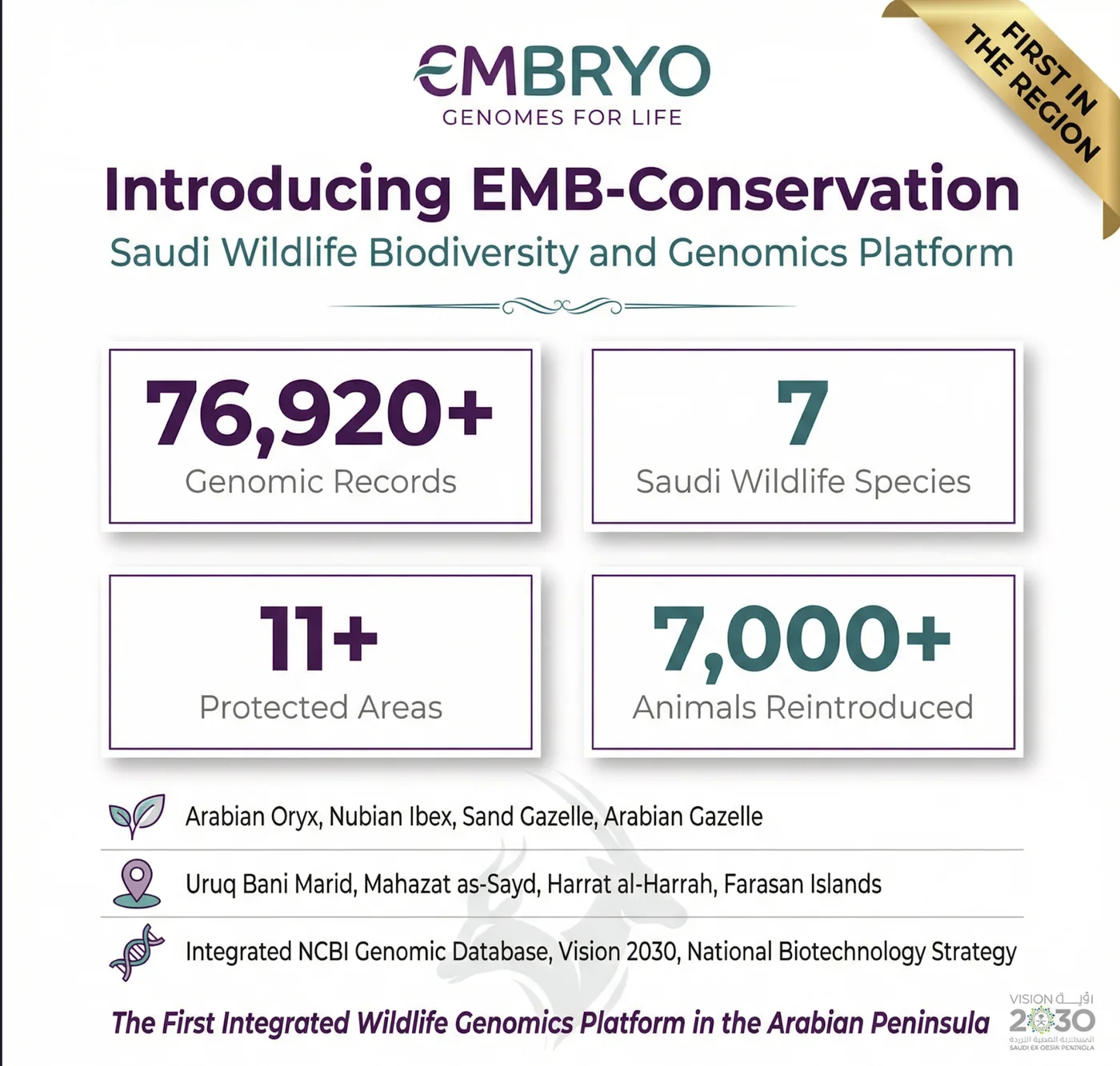
EMB-Conservation — Saudi Wildlife Genomics Platform
First integrated wildlife biodiversity & genomics platform in the Arabian Peninsula
Saudi Arabia's first integrated conservation genomics platform — combining 76,920+ NCBI genomic records, field eDNA sampling, and population genomics across 7 flagship species in 11+ protected areas. Tracks genetic diversity, guides reintroduction programs, and provides government-ready conservation reports.
KEY FINDINGS
- ▸76,920+ genomic records integrated from NCBI and field sampling
- ▸7 Saudi wildlife species tracked: Arabian Oryx, Nubian Ibex, Sand & Arabian Gazelle + more
- ▸11+ protected areas monitored: Uruq Bani Marid, Mahazat as-Sayd, Harrat al-Harrah, Farasan
- ▸7,000+ animals reintroduced — genomic guidance for breeding programs
CAPABILITIES DEMONSTRATED

Seed NGS Platform — seed.embryo.sa
Next-generation sequencing for crop improvement & seed quality in Saudi Arabia
Saudi Arabia's dedicated plant genomics and seed omics platform — providing end-to-end NGS services for crop improvement, seed quality certification, variety authentication, and agricultural sustainability. Powered by Embryo's bioinformatics infrastructure, the platform serves breeders, research institutions, and the Ministry of Environment, Water & Agriculture (MEWA).
KEY FINDINGS
- ▸Seed variety authentication using genome-wide SNP fingerprinting
- ▸Marker-assisted selection (MAS) for drought, heat, and salinity tolerance
- ▸Date palm (*Phoenix dactylifera*) variety identification and purity testing
- ▸Wheat and barley cultivar genomics for Vision 2030 food security goals
CAPABILITIES DEMONSTRATED

Clinical Variant Pathogenicity Scoring
ClinVar-HGMD integrated evidence framework for TOP-50 candidates
A comprehensive multi-source pathogenicity classification system integrating ClinVar, HGMD, gnomAD, and functional prediction tools (SIFT, PolyPhen, CADD, GERP) to assign evidence-based pathogenicity scores (0–10) to a set of 50 priority candidate variants.
KEY FINDINGS
- ▸50 priority variants scored across 5 pathogenicity categories
- ▸ClinVar clinical significance, HGMD disease-causing status, CADD/GERP integrated
- ▸Population frequency (gnomAD) weighted into scoring model
- ▸Output: Pathogenic | Likely Pathogenic | VUS | Likely Benign | Benign
CAPABILITIES DEMONSTRATED
What the Portfolio Covers
FIGURE — PROJECT PORTFOLIO BY STATUS
FIGURE — PORTFOLIO BY DOMAIN
Commission Research
Our team handles end-to-end genomics research — from sample collection and sequencing to statistical analysis, manuscript preparation, and clinical reporting.